Introduction
Functional depth is a measure of how “central” or “typical” a curve is within a sample of curves. Curves with high depth are considered representative of the sample, while curves with low depth are outliers or extreme observations.
Depth functions extend the concept of statistical depth (like data depth for multivariate data) to the infinite-dimensional setting of functional data.
library(fdars)
#>
#> Attaching package: 'fdars'
#> The following objects are masked from 'package:stats':
#>
#>     cov, decompose, deriv, median, sd, var
#> The following object is masked from 'package:base':
#>
#>     norm
library(ggplot2)
theme_set(theme_minimal())

# Create example data
set.seed(42)
n <- 30
m <- 100
t_grid <- seq(0, 1, length.out = m)

# Main sample: sine curves with noise
X <- matrix(0, n, m)
for (i in 1:n) {
  X[i, ] <- sin(2 * pi * t_grid) + rnorm(m, sd = 0.15)
}

# Add some outliers
X[1, ] <- sin(2 * pi * t_grid) + 2  # Magnitude outlier
X[2, ] <- cos(2 * pi * t_grid)       # Shape outlier

fd <- fdata(X, argvals = t_grid)
plot(fd)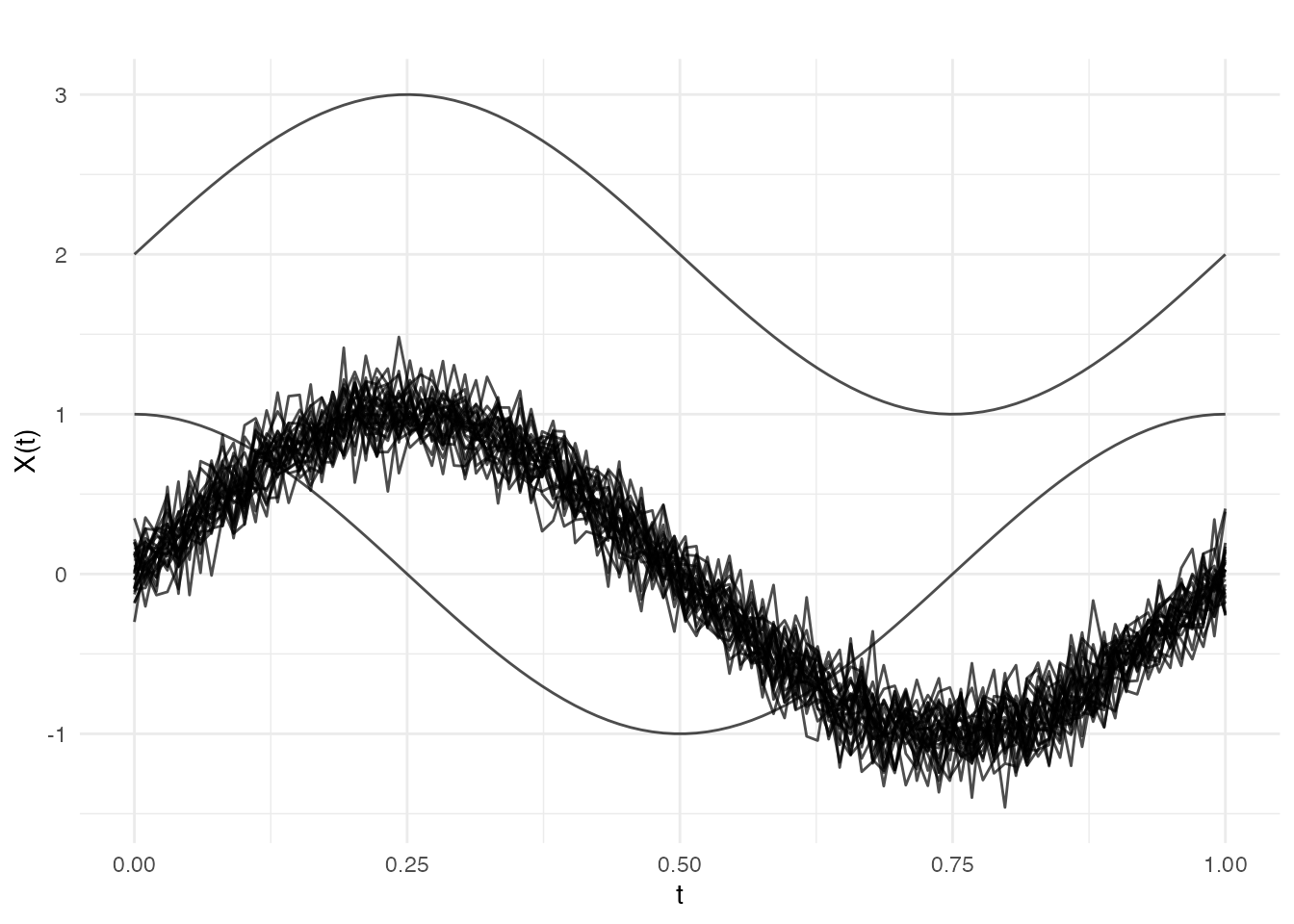
Available Depth Functions
All depth functions are accessed through the unified
depth() function with a method parameter.
Fraiman-Muniz Depth (method = “FM”)
The Fraiman-Muniz depth integrates univariate depths across the domain. For each time point, it computes the proportion of curves above and below the given curve, then averages across time.
depths_fm <- depth(fd, method = "FM")

# Show depths (outliers should have lower depth)
data.frame(
  curve = 1:5,
  depth = round(depths_fm[1:5], 4),
  note = c("magnitude outlier", "shape outlier", rep("normal", 3))
)
#>   curve  depth              note
#> 1     1 0.0000 magnitude outlier
#> 2     2 0.1113     shape outlier
#> 3     3 0.5233            normal
#> 4     4 0.5707            normal
#> 5 5 0.5407 normalIntuition: At each time point, FM depth asks: “What proportion of curves lie above and below this curve?” A curve that is consistently in the middle of the data cloud at every time point will have high FM depth.
The FM depth can be scaled to [0, 1] using the scale
parameter:
Modal Depth (method = “mode”)
Modal depth uses kernel density estimation in function space. Curves in high-density regions have high depth.
depths_mode <- depth(fd, method = "mode")
head(depths_mode)
#> [1] 0.03335153 0.09401245 0.83156568 0.84229565 0.83229521 0.82640249Intuition: Modal depth estimates local density in function space. Curves in “crowded” regions (where many similar curves exist) have high depth. Think of it like finding the mode of a distribution, but for curves.
Random Projection Depth (method = “RP”)
Projects curves onto random directions and computes univariate depths of the projections. More robust to local variations.
depths_rp <- depth(fd, method = "RP", nproj = 50)
head(depths_rp)
#> [1] 0.05096774 0.08258065 0.27096774 0.30000000 0.23806452 0.23032258Intuition: RP depth projects all curves onto random 1D directions and computes depth there. It’s robust because outliers can’t hide from all projection angles - if a curve is unusual, some projection will reveal it.
Random Tukey Depth (method = “RT”)
Takes the minimum depth across random projections, similar to Tukey’s halfspace depth. Very robust to outliers.
depths_rt <- depth(fd, method = "RT", nproj = 50)
head(depths_rt)
#> [1] 0.03225806 0.03225806 0.03225806 0.06451613 0.03225806 0.03225806Intuition: RT depth takes the minimum depth across all projections. This is very conservative - a curve is only considered central if it looks central from every angle. This makes RT extremely robust to outliers.
Functional Spatial Depth (method = “FSD”)
Based on unit vectors pointing from each curve to all others. Measures centrality in a geometric sense.
depths_fsd <- depth(fd, method = "FSD")
head(depths_fsd)
#> [1] 0.03927198 0.06164440 0.34346531 0.39240477 0.33894657 0.32391302Intuition: FSD computes unit vectors from each curve to all others. A central curve has these vectors pointing in all directions (they cancel out), resulting in high depth. An outlier has most vectors pointing in one direction (away from the data cloud).
Kernel Functional Spatial Depth (method = “KFSD”)
Smoothed version of FSD using a Gaussian kernel. The bandwidth
h controls the smoothing.
Random Projection Depth with Derivatives (method = “RPD”)
Incorporates derivative information, making it sensitive to shape changes in addition to magnitude.
depths_rpd <- depth(fd, method = "RPD", nproj = 50)
head(depths_rpd)
#> [1] 0.08133333 0.10266667 0.21400000 0.22200000 0.18733333 0.18533333Intuition: RPD is like RP, but the projections are based on curve derivatives. This makes it sensitive to shape differences - curves with unusual wiggliness or local behavior will have low depth even if their overall level is typical.
Comparing Depth Functions
Different depth functions have different properties and may rank curves differently:
# Compute all depths using unified depth() function
all_depths <- data.frame(
  FM = depth(fd, method = "FM"),
  mode = depth(fd, method = "mode"),
  RP = depth(fd, method = "RP", nproj = 50),
  RT = depth(fd, method = "RT", nproj = 50),
  FSD = depth(fd, method = "FSD")
)

# Correlation between depth functions
round(cor(all_depths), 2)
#>        FM mode   RP   RT  FSD
#> FM   1.00 0.98 0.93 0.16 0.98
#> mode 0.98 1.00 0.94 0.16 0.97
#> RP   0.93 0.94 1.00 0.18 0.93
#> RT   0.16 0.16 0.18 1.00 0.17
#> FSD  0.98 0.97 0.93 0.17 1.00
# Which curves are identified as outliers (lowest depth)?
outlier_ranks <- apply(all_depths, 2, function(d) order(d)[1:3])
outlier_ranks
#>      FM mode RP RT FSD
#> [1,]  1    1  1  1   1
#> [2,]  2    2  2  2   2
#> [3,] 10   10 23  3  10
All depth functions correctly identify curves 1 and 2 as having low depth.
Visualizing Depth
A powerful way to understand depth is to color curves by their depth values:
# Visualize curves colored by their FM depth
df_depth_viz <- data.frame(
  t = rep(t_grid, n),
  value = as.vector(t(X)),
  curve = rep(1:n, each = m),
  depth = rep(depths_fm, each = m)
)

ggplot(df_depth_viz, aes(x = t, y = value, group = curve, color = depth)) +
  geom_line(alpha = 0.8) +
  scale_color_viridis_c(option = "plasma", name = "FM Depth") +
  labs(title = "Curves Colored by Depth",
       subtitle = "Dark = low depth (outlier), Bright = high depth (central)",
       x = "t", y = "X(t)")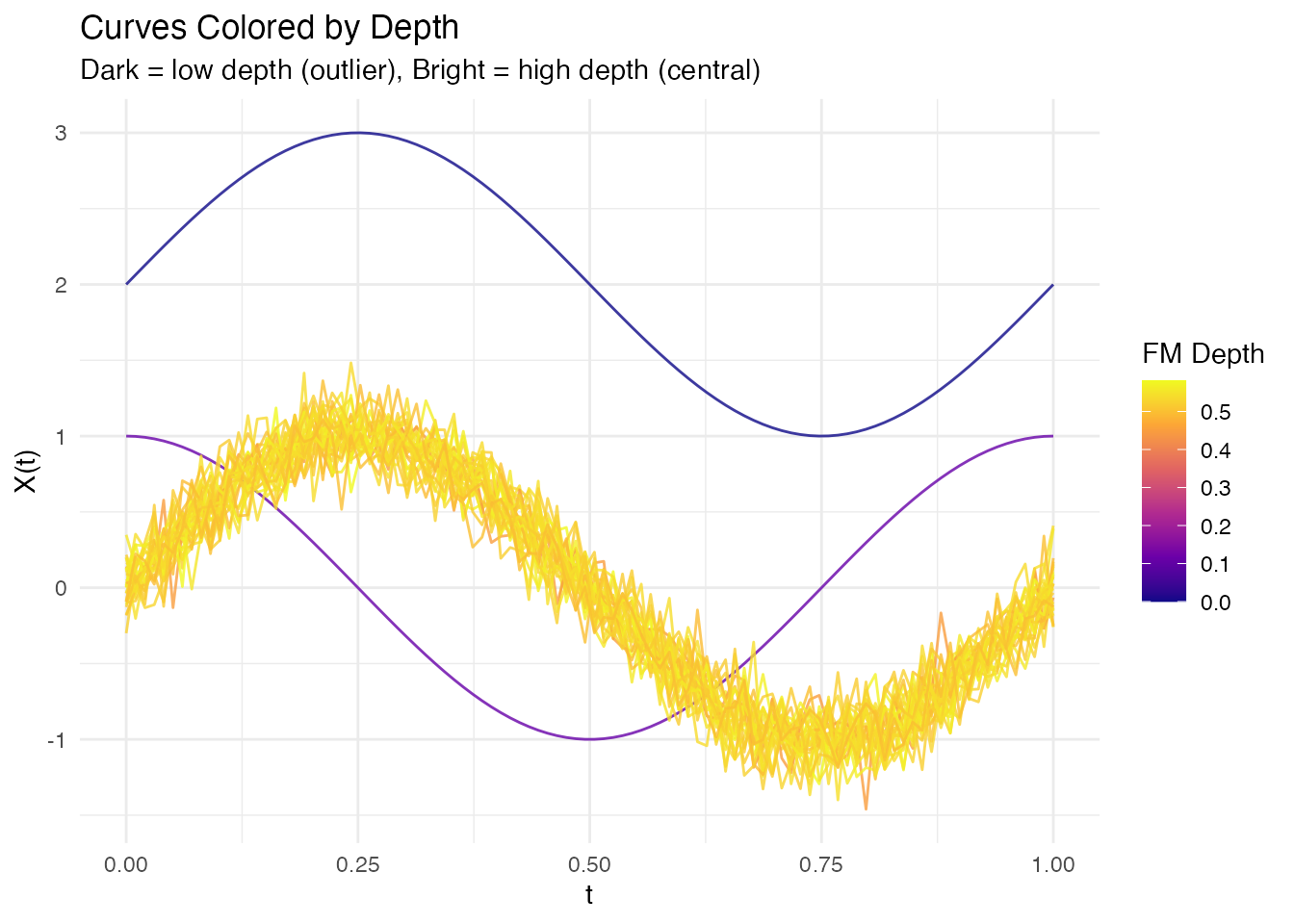
This visualization immediately reveals which curves are outliers (dark colors) and which are central (bright colors). The magnitude outlier (shifted up) and shape outlier (cosine instead of sine) both appear with low depth values.
Depth-Based Statistics
Trimmed Mean
Remove a proportion of curves with lowest depth, then compute the mean:
# 10% trimmed mean using different depth methods
trim_fm <- trimmed(fd, trim = 0.1, method = "FM")
trim_mode <- trimmed(fd, trim = 0.1, method = "mode")

# Compare trimmed mean to regular mean
mean_curve <- mean(fd)
# Visualize: trimmed mean is more robust to outliers
df_compare <- data.frame(
  t = rep(t_grid, 2),
  value = c(mean_curve$data[1, ], trim_fm$data[1, ]),
  type = rep(c("Mean", "Trimmed Mean (FM)"), each = m)
)

library(ggplot2)
ggplot(df_compare, aes(x = t, y = value, color = type)) +
  geom_line(linewidth = 1.2) +
  labs(title = "Mean vs Trimmed Mean",
       x = "t", y = "X(t)", color = "") +
  theme_minimal()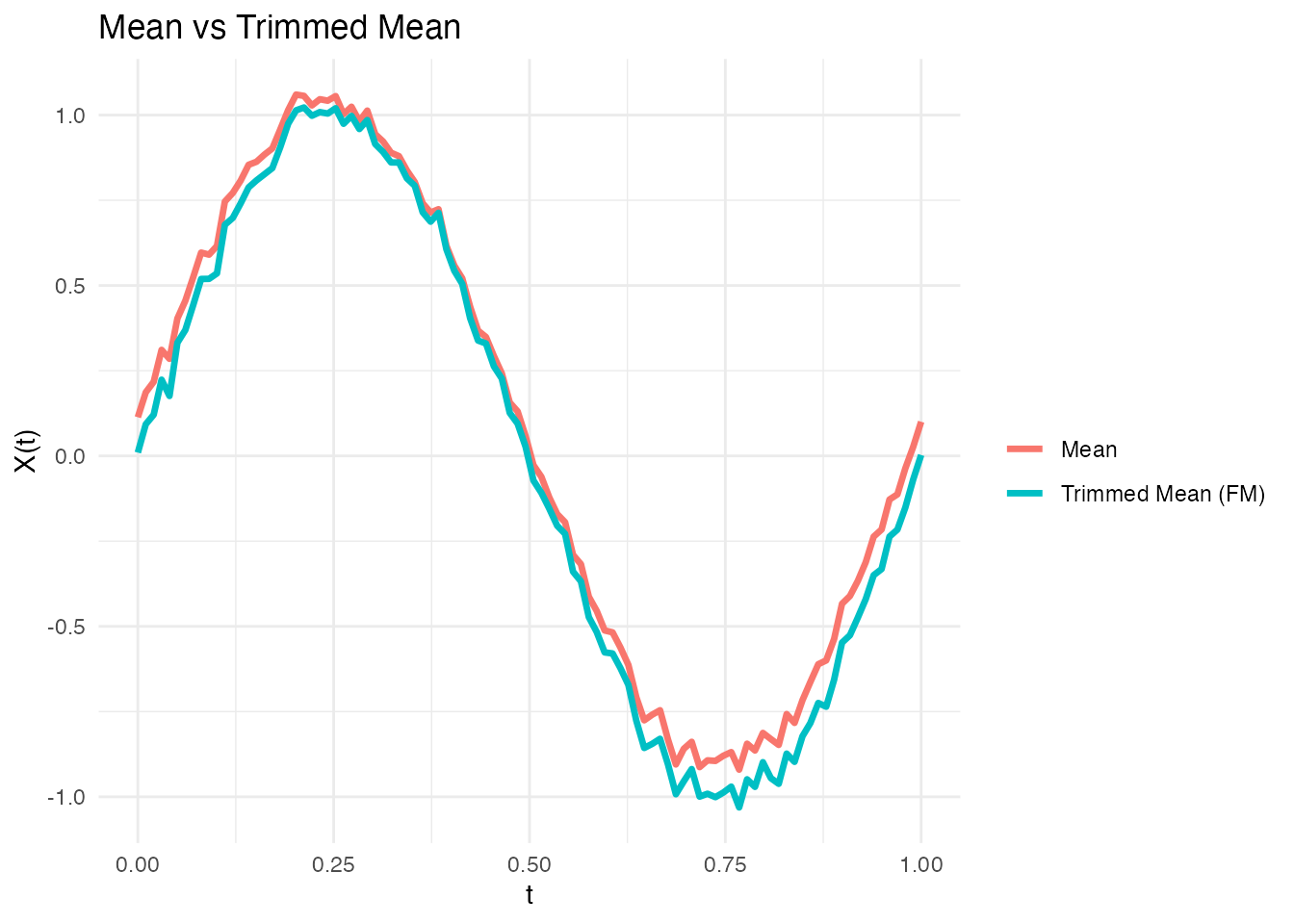
Choosing a Depth Function
| Depth | Strengths | Best For |
|---|---|---|
| FM | Simple, interpretable | General use |
| mode | Sensitive to local density | Multimodal data |
| RP | Robust, fast | Large datasets |
| RT | Very robust | Heavy outlier contamination |
| FSD | Geometric interpretation | Spatial patterns |
| KFSD | Smooth, tunable | When smoothness matters |
| RPD | Shape-sensitive | When derivatives matter |
Performance
All depth computations use a parallel Rust backend:
# Large dataset benchmark
X_large <- matrix(rnorm(500 * 200), 500, 200)
fd_large <- fdata(X_large)

system.time(depth(fd_large, method = "FM"))
#>    user  system elapsed
#>   0.032   0.000   0.032

system.time(depth(fd_large, method = "RP", nproj = 100))
#>    user  system elapsed
#>   0.089   0.000   0.089
References
- Fraiman, R. and Muniz, G. (2001). Trimmed means for functional data. Test, 10(2), 419-440.
- Cuevas, A., Febrero, M., and Fraiman, R. (2007). Robust estimation and classification for functional data via projection-based depth notions. Computational Statistics, 22(3), 481-496.
- López-Pintado, S. and Romo, J. (2009). On the concept of depth for functional data. Journal of the American Statistical Association, 104(486), 718-734.