Creates an irregFdata object from regular fdata by randomly
selecting a subset of observation points for each curve.
Arguments
- fdataobj
An object of class
fdata.- minObs
Minimum number of observations to keep per curve.
- maxObs
Maximum number of observations to keep per curve. If
NULL, uses the total number of points.- prob
Sampling probability function. If
NULL, uniform sampling is used. Otherwise, a function that takesargvalsand returns sampling weights (not necessarily normalized).- seed
Optional integer random seed for reproducibility.
Details
For each curve, the function:
Draws a random number of points to keep between
minObsandmaxObsSamples that many points (without replacement) from the grid
If
probis provided, sampling is weighted accordingly
Common probability functions:
Uniform:
NULL(default)More points in middle:
function(t) dnorm(t, mean = 0.5, sd = 0.2)More points at ends:
function(t) 1 - dnorm(t, mean = 0.5, sd = 0.2)
Examples
# Create regular functional data
t <- seq(0, 1, length.out = 100)
fd <- simFunData(n = 20, argvals = t, M = 5, seed = 42)
# Uniform sparsification
ifd <- sparsify(fd, minObs = 10, maxObs = 30, seed = 123)
print(ifd)
#> Irregular Functional Data Object
#> =================================
#> Number of observations: 20
#> Points per curve:
#> Min: 10
#> Median: 24
#> Max: 29
#> Total: 441
#> Domain: [ 0 , 1 ]
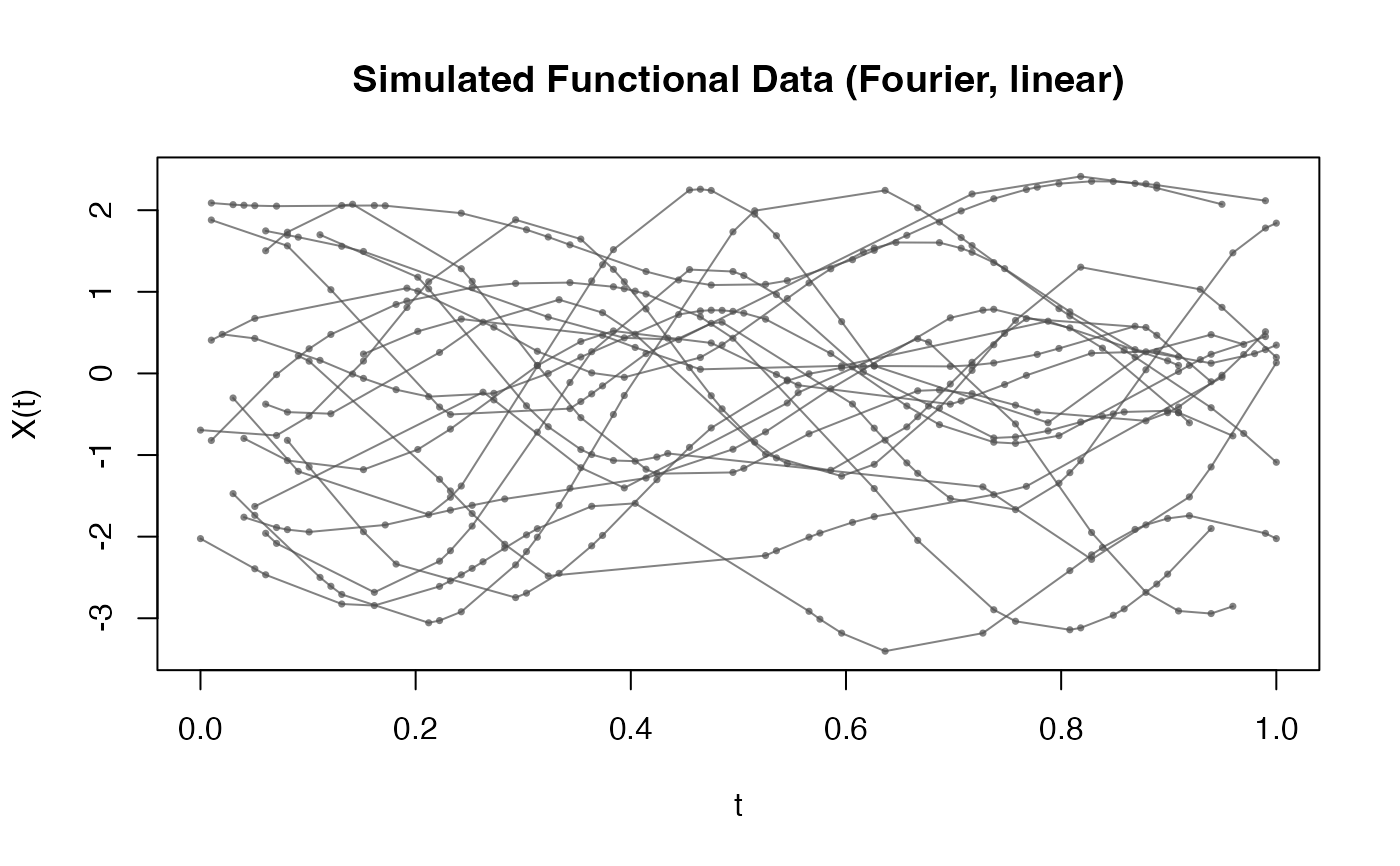
plot(ifd)
 # Non-uniform: more observations in the middle
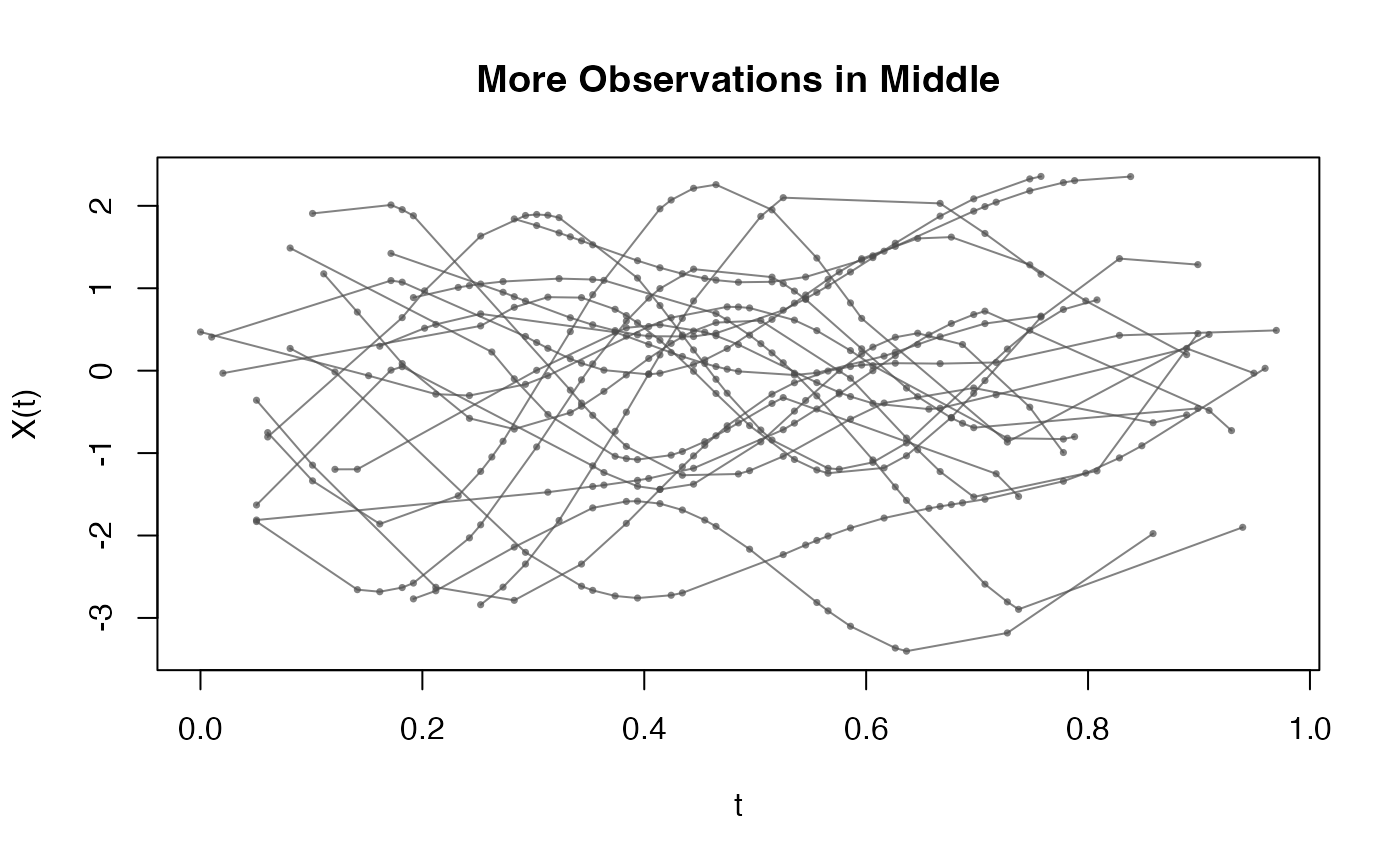
prob_middle <- function(t) dnorm(t, mean = 0.5, sd = 0.2)
ifd_middle <- sparsify(fd, minObs = 15, maxObs = 25, prob = prob_middle, seed = 123)
plot(ifd_middle, main = "More Observations in Middle")
# Non-uniform: more observations in the middle
prob_middle <- function(t) dnorm(t, mean = 0.5, sd = 0.2)
ifd_middle <- sparsify(fd, minObs = 15, maxObs = 25, prob = prob_middle, seed = 123)
plot(ifd_middle, main = "More Observations in Middle")