fdars
Treat entire curves, spectra, and trajectories as single observations — then smooth, align, decompose, and model them at native speed.
Every method crosses into compiled Rust via PyO3 — no Python loop over your curves, with parallelism where it counts.
FPCA, elastic alignment, functional regression, depth, clustering, process monitoring, conformal — 17 modules.
Powered by the fdars-core engine that also drives the fdars R package.
Plain ndarray in, ndarray out. Pre-built wheels for Linux, macOS & Windows; NumPy is the only runtime dependency.
The Fdata Class
The central object in fdars is Fdata -- a functional data container that
bundles observation data, evaluation grid, identifiers, and per-observation
metadata into a single object (mirroring the R package's fdata class).
import numpy as np
import pandas as pd
from fdars import Fdata

# Create functional data from a (n_obs, n_points) array + grid
t = np.linspace(0, 1, 100)
X = np.random.randn(30, 100)

# Attach metadata as a pandas DataFrame
meta = pd.DataFrame({
    "group": ["control"] * 15 + ["treatment"] * 15,
    "age": np.random.randint(20, 60, 30),
})
fd = Fdata(X, argvals=t, metadata=meta)
fd
# Fdata (1D)  –  30 obs × 100 points  –  range [0.0, 1.0]  –  metadata: group, age

# Methods delegate to the Rust backend
mu = fd.mean()                     # pointwise mean
fd_c = fd.center()                 # centered Fdata
d1 = fd.deriv(nderiv=1)            # first derivative (returns Fdata)
norms = fd.norm(p=2.0)             # L2 norms per curve
depths = fd.depth("fraiman_muniz") # depth values
D = fd.distance(method="lp")       # self-distance matrix

# Subset -- metadata DataFrame and IDs are preserved
fd_sub = fd[0:10]
fd_sub.metadata  # DataFrame with 10 rows
See the Fdata reference and Introduction for a full walkthrough.
Tutorials and guides to get started with functional data analysis in Python.
Basis expansions, dimensionality reduction, depth, and distances for functional data.

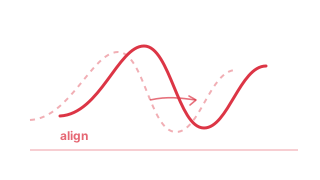
Curve registration and elastic alignment methods.
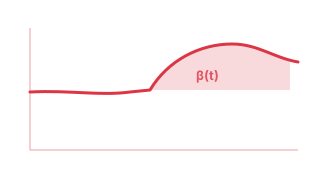
Functional regression, classification, and prediction.
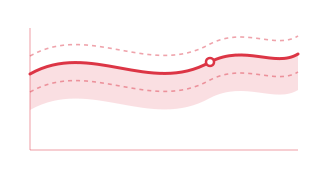
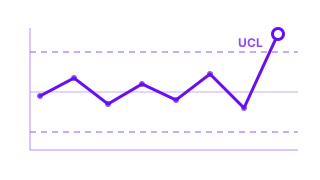
Statistical process monitoring for functional profiles.
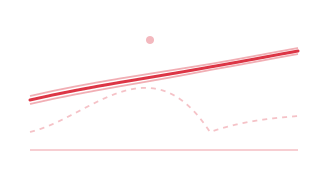
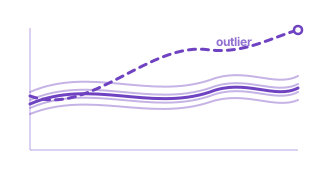
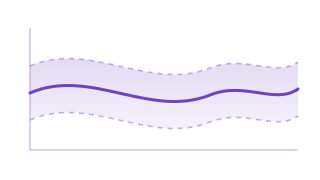
Clustering, outlier detection, tolerance bands, and seasonal decomposition.
Installation
fdars ships pre-built wheels for Linux, macOS, and Windows on Python 3.9+. The only runtime dependency is NumPy.
Development install
To build from source (requires a Rust toolchain):
Quick Example
A minimal end-to-end workflow: create an Fdata object, compute depth
rankings, and cluster.
import numpy as np
import pandas as pd
from fdars import Fdata
from fdars.simulation import simulate
from fdars.clustering import kmeans_fd

# 1. Simulate 60 curves on a regular grid
argvals = np.linspace(0, 1, 100)
data = simulate(n=60, argvals=argvals, n_basis=7, seed=42)

# 2. Wrap in an Fdata object with metadata
meta = pd.DataFrame({"batch": np.repeat(["A", "B", "C"], 20)})
fd = Fdata(data, argvals=argvals, metadata=meta)
print(fd)
# Fdata (1D)  –  60 obs × 100 points  –  range [0.0, 1.0]  –  metadata: batch

# 3. Rank curves by Fraiman-Muniz depth
depths = fd.depth("fraiman_muniz")
deepest = np.argmax(depths)
print(f"Most central curve: {deepest}, depth = {depths[deepest]:.4f}")

# 4. Center the data
fd_c = fd.center()     # returns Fdata with metadata preserved

# 5. Cluster into 3 groups
result = kmeans_fd(fd.data, fd.argvals, k=3, seed=0)
print(f"Cluster sizes: {np.bincount(result['cluster'])}")
Rust under the hood
Every method call on Fdata crosses into compiled Rust code via
PyO3. There is no Python loop over the 60
curves -- the entire computation runs at native speed with
multithreaded parallelism where applicable.
Package Modules
| Module | Description |
|---|---|
fdars.Fdata |
Functional data container — the main entry point (1D curves, 2D surfaces, metadata) |
fdars.fdata |
Low-level functional data operations: mean, center, derivatives, norms, normalization |
fdars.depth |
Fraiman-Muniz, modal, band, random projection, Tukey, spatial depth |
fdars.metric |
Lp, Hausdorff, DTW, Soft-DTW, Fourier, horizontal-shift |
fdars.basis |
B-spline, Fourier, P-spline basis operations |
fdars.smoothing |
Nadaraya-Watson, local polynomial, k-NN, bandwidth CV |
fdars.clustering |
K-means, fuzzy c-means, GMM |
fdars.regression |
FPCA, PLS, nonparametric, robust, FOSR, FANOVA |
fdars.alignment |
SRSF alignment, Karcher mean, elastic FPCA |
fdars.outliers |
LRT, outliergram, magnitude-shape |
fdars.seasonal |
SAZED, autoperiod, STL, peak detection |
fdars.spm |
Phase I/II, EWMA, CUSUM process monitoring |
fdars.classification |
LDA, QDA, k-NN, kernel classifiers |
fdars.tolerance |
FPCA, conformal, Degras tolerance/confidence bands |
fdars.conformal |
Split conformal, jackknife+ prediction |
fdars.simulation |
Karhunen-Loeve simulation, Gaussian processes |
fdars.explain |
SHAP, PDP, permutation importance, significant regions |