Learn
Welcome to the fdars learning hub. These guides walk you through the core ideas of functional data analysis and show you how to apply them with fdars's Python API.
Where to start
If you are new to FDA or fdars, begin with the Introduction -- it covers the mental model, data layout, and a complete first analysis.
Guides
Introduction to fdars
What is functional data analysis? Understand the core concepts, learn how
fdars represents curves as NumPy arrays, and run your first end-to-end
analysis.
Custom Plotting
Visualize Fdata with matplotlib: curve families, colouring by metadata,
mean bands, and highlighting the functional median.
Simulation Toolbox
Generate realistic synthetic curves with Karhunen-Loeve expansions
(Fourier, polynomial, Wiener eigenfunctions) and Gaussian processes
(Gaussian, exponential, Matern, periodic kernels).
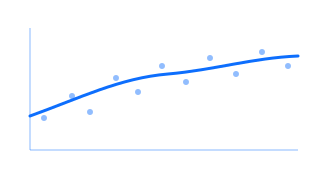
Smoothing
Remove noise while preserving structure. Covers Nadaraya-Watson,
local polynomial regression, k-NN smoothing, bandwidth selection via
cross-validation, and basis smoothing with P-splines.
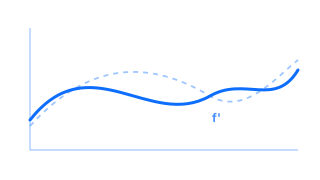
Working with Derivatives
Compute first, second, and higher-order derivatives for 1D and 2D
functional data. Learn how to combine differentiation with smoothing
for stable estimates.
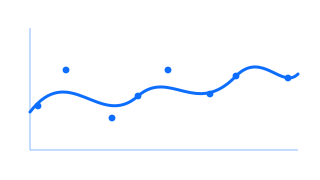
Irregular Sampling
Work with sparse, unevenly-sampled curves by smoothing each onto a shared
grid before analysis.
Suggested Reading Order
- Introduction to fdars -- concepts and first steps
- Simulation Toolbox -- generate data for experiments
- Smoothing -- prepare raw data for analysis
- Working with Derivatives -- extract rate-of-change information
After completing the Learn guides, explore the topic-specific sections: Represent, Align, Regression, Monitoring, and Analyze.