Clustering
Partition a set of functional observations into homogeneous groups. fdars provides three clustering algorithms -- hard (k-means), soft (fuzzy c-means), and model-based (GMM) -- together with two cluster-quality indices for selecting the number of clusters.
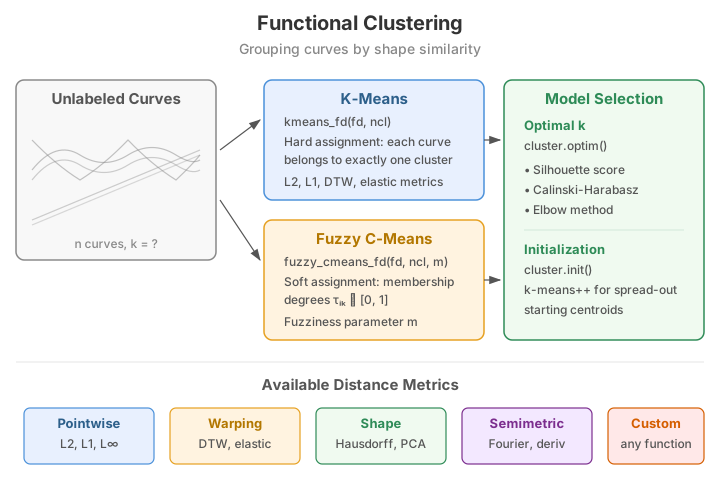
K-means for functional data
The functional k-means algorithm minimises the total within-cluster \(L^2\) distance, iterating between assignment and centroid update until convergence. Writing \(c_k\) for the \(k\)-th centroid curve and \(C_k\) for the observations assigned to it, the objective is
with the centroid update setting each \(c_k\) to the mean curve of its cluster.
import numpy as np
from fdars import Fdata
from fdars.simulation import simulate
from fdars.clustering import kmeans_fd

# Two well-separated groups
argvals = np.linspace(0, 1, 100)
group_a = simulate(30, argvals, n_basis=5, seed=1)
group_b = simulate(30, argvals, n_basis=5, seed=2) + 3.0
fd = Fdata(np.vstack([group_a, group_b]), argvals=argvals)

result = kmeans_fd(fd.data, fd.argvals, k=2, max_iter=100, tol=1e-6, seed=42)
Parameters
| Parameter | Type | Default | Description |
|---|---|---|---|
data |
ndarray (n, m) |
-- | Functional observations |
argvals |
ndarray (m,) |
-- | Evaluation grid |
k |
int |
-- | Number of clusters |
max_iter |
int |
100 |
Maximum iterations |
tol |
float |
1e-6 |
Convergence tolerance |
seed |
int |
42 |
Random seed for initialisation |
Returns a dictionary:
| Key | Shape / Type | Description |
|---|---|---|
cluster |
(n,) int |
Cluster label for each observation |
centers |
(k, m) |
Cluster centroid curves |
tot_withinss |
float |
Total within-cluster sum of squares |
iter |
int |
Number of iterations performed |
converged |
bool |
Whether the algorithm converged |
Fuzzy C-means
Fuzzy c-means assigns each observation a membership degree \(u_{ik} \in [0, 1]\) for every cluster rather than a hard label, controlled by the fuzziness parameter \(m\) (default 2). It minimises the weighted within-cluster objective
so larger \(m\) flattens the memberships toward the uniform value \(1/K\) and softens the partition.
from fdars.clustering import fuzzy_cmeans_fd

result_fcm = fuzzy_cmeans_fd(
    fd.data, fd.argvals, k=2, fuzziness=2.0, max_iter=100, tol=1e-6, seed=42
)
Parameters
| Parameter | Type | Default | Description |
|---|---|---|---|
data |
ndarray (n, m) |
-- | Functional observations |
argvals |
ndarray (m,) |
-- | Evaluation grid |
k |
int |
-- | Number of clusters |
fuzziness |
float |
2.0 |
Fuzziness exponent (\(> 1\)) |
max_iter |
int |
100 |
Maximum iterations |
tol |
float |
1e-6 |
Convergence tolerance |
seed |
int |
42 |
Random seed |
Returns a dictionary:
| Key | Shape / Type | Description |
|---|---|---|
cluster |
(n,) int |
Hard assignment (argmax of membership) |
membership |
(n, k) |
Membership degree matrix |
centers |
(k, m) |
Cluster centroid curves |
Interpreting membership
A membership value of 0.95 for cluster 1 and 0.05 for cluster 2 indicates a clearly assigned point. Values near 0.50/0.50 indicate boundary observations that sit between clusters.
The fuzziness parameter \(m\)
The fuzziness exponent controls how soft the memberships are:
- \(m \to 1^+\): memberships collapse toward hard 0/1 assignments (like k-means);
- \(m = 2\): the standard default -- soft, well-behaved memberships;
- \(m > 2\): softer, more overlapping memberships.
Sweeping \(m\) shows the average maximum membership decreasing as \(m\) grows -- the clusters become progressively fuzzier.
import numpy as np
from docs_fig import fig, render
from fdars.simulation import simulate
from fdars.clustering import fuzzy_cmeans_fd

t = np.linspace(0, 1, 80)
X = np.vstack([
    np.asarray(simulate(20, t, n_basis=5, seed=1)),
    np.asarray(simulate(20, t, n_basis=5, seed=2)) + 3.0,
    np.asarray(simulate(20, t, n_basis=5, seed=3)) - 3.0,
])

ms = [1.1, 1.5, 2.0, 2.5, 3.0]
avg_max = [
    float(np.asarray(fuzzy_cmeans_fd(X, t, k=3, fuzziness=m, seed=42)["membership"]).max(1).mean())
    for m in ms
]

f, ax = fig(figsize=(7.0, 3.6))
ax.plot(ms, avg_max, "-o", color="#6f42c1", lw=1.8)
ax.set(title="Average maximum membership vs. fuzziness m",
       xlabel="fuzziness m", ylabel="mean of row-max membership", ylim=(0.4, 1.02))
print(render(f))
At \(m = 1.1\) nearly every curve is essentially hard-assigned (mean max membership close to 1); by \(m = 3\) the memberships are much softer.
Membership as an outlier signal
A curve with a low maximum membership belongs strongly to no cluster -- it sits on a boundary or is an outlier. Flagging the lowest-membership decile is a cheap, model-based outlier screen (see Outlier detection for dedicated methods).
Model-based clustering
For a probabilistic mixture model -- posterior membership probabilities and automatic
selection of the number of components via BIC/ICL -- see the dedicated
GMM clustering page (gmm_cluster). For clustering that first aligns
curves to remove phase variation, see Elastic clustering.
Cluster quality indices
Silhouette score
The silhouette score measures how similar each observation is to its own cluster compared with the nearest neighbouring cluster. Values range from \(-1\) (misclassified) to \(+1\) (perfectly clustered).
from fdars.clustering import silhouette_score
from fdars.metric import lp_self_1d

dist_matrix = lp_self_1d(fd.data, fd.argvals, p=2.0)
labels = result["cluster"].astype(np.int64)
sil = silhouette_score(dist_matrix, labels)
print(f"Mean silhouette: {np.mean(sil):.3f}")
Calinski-Harabasz index
A higher Calinski-Harabasz index indicates better-defined clusters (larger between-cluster variance relative to within-cluster variance).
from fdars.clustering import calinski_harabasz

ch = calinski_harabasz(dist_matrix, labels)
print(f"Calinski-Harabasz: {ch:.1f}")
Convenience variants that skip the distance matrix
silhouette_score_data(data, argvals, labels) and
calinski_harabasz_data(data, argvals, labels) compute the \(L^2\) distance matrix
internally, so you can pass the raw curves directly instead of precomputing
lp_self_1d.
Selecting the optimal number of clusters
A common strategy is to run k-means for several values of \(k\) and pick the one that maximises the mean silhouette score.
import numpy as np
from fdars import Fdata
from fdars.simulation import simulate
from fdars.clustering import kmeans_fd, silhouette_score
from fdars.metric import lp_self_1d

# Three-group data
argvals = np.linspace(0, 1, 100)
g1 = simulate(25, argvals, n_basis=5, seed=1)
g2 = simulate(25, argvals, n_basis=5, seed=2) + 8.0
g3 = simulate(25, argvals, n_basis=5, seed=3) + 16.0
fd = Fdata(np.vstack([g1, g2, g3]), argvals=argvals)

dist = lp_self_1d(fd.data, fd.argvals, p=2.0)

scores = {}
for k in range(2, 9):
    res = kmeans_fd(fd.data, fd.argvals, k=k, seed=42)
    labels = res["cluster"].astype(np.int64)
    sil = silhouette_score(dist, labels)
    scores[k] = float(np.mean(sil))
    print(f"k={k}  silhouette={scores[k]:.3f}")

best_k = max(scores, key=scores.get)
print(f"\nOptimal k = {best_k}")
A complementary diagnostic is the elbow method: plot the total within-cluster sum of
squares (tot_withinss) against \(k\) and look for the "elbow" where adding clusters stops
buying much reduction in scatter. For three well-separated groups both criteria agree at
\(k = 3\).
import numpy as np
from docs_fig import fig, render
from fdars.simulation import simulate
from fdars.clustering import kmeans_fd

t = np.linspace(0, 1, 80)
X = np.vstack([
    np.asarray(simulate(15, t, n_basis=5, seed=1)),
    np.asarray(simulate(15, t, n_basis=5, seed=2)) + 8.0,
    np.asarray(simulate(15, t, n_basis=5, seed=3)) + 16.0,
])

ks = list(range(1, 8))
wss = [float(kmeans_fd(X, t, k=k, seed=42)["tot_withinss"]) for k in ks]

f, ax = fig(figsize=(7.0, 3.6))
ax.plot(ks, wss, "-o", color="#198754", lw=1.8)
ax.axvline(3, color="#e8710a", ls="--", lw=1.2, label="elbow at k = 3")
ax.set(title="Elbow method: total within-cluster SS vs. k",
       xlabel="k", ylabel="tot_withinss")
ax.legend()
print(render(f))
The within-cluster scatter drops steeply from \(k = 1\) to \(k = 3\) and then flattens, so the curve bends sharply at \(k = 3\) -- the elbow -- agreeing with the silhouette peak and correctly recovering the three planted groups.
Using different distance metrics
kmeans_fd uses \(L^2\) distance internally. When clusters differ mainly by a phase
shift (a horizontal translation), \(L^2\) can be misled -- two curves that are identical
up to a small time shift look far apart pointwise. Computing a shift-tolerant distance
matrix (DTW, Hausdorff) and feeding the resulting labels to the quality indices lets you
compare how well a labeling holds up under an alternative metric.
import numpy as np
from docs_fig import fig, render
from fdars.metric import lp_self_1d, dtw_self_1d
from fdars.clustering import silhouette_score, kmeans_fd

rng = np.random.default_rng(456)
t = np.linspace(0, 1, 80)
# Two groups that differ only by a phase shift of 0.5 rad
X = np.vstack([
    np.array([np.sin(2 * np.pi * t) + rng.normal(0, 0.3, t.size) for _ in range(30)]),
    np.array([np.sin(2 * np.pi * t + 0.5) + rng.normal(0, 0.3, t.size) for _ in range(30)]),
])
labels = np.array([0] * 30 + [1] * 30)

d_l2 = np.asarray(lp_self_1d(X, t, p=2.0))
d_dtw = np.asarray(dtw_self_1d(X, p=2.0, w=10))
sil_l2 = float(np.mean(np.asarray(silhouette_score(d_l2, labels))))
sil_dtw = float(np.mean(np.asarray(silhouette_score(d_dtw, labels))))

f, ax = fig(figsize=(6.5, 3.6))
ax.bar(["L2", "DTW"], [sil_l2, sil_dtw], color=["#3f51b5", "#e8710a"], width=0.55)
ax.set(title="Silhouette of the true labels under two metrics\n(phase-shifted groups)",
       ylabel="mean silhouette")
for i, v in enumerate([sil_l2, sil_dtw]):
    ax.text(i, v, f"{v:.3f}", ha="center", va="bottom")
print(render(f))
Under DTW the two phase-shifted groups score a higher silhouette than under \(L^2\), because DTW absorbs the timing difference. If your groups genuinely differ by shape and not by timing, consider the elastic clustering methods, which separate amplitude from phase explicitly.
Full example -- recovering three known groups
With a labeled simulation we can check that k-means recovers the true partition. Cluster labels are arbitrary up to a permutation, so accuracy is the best match over all label permutations -- exactly the "confusion-matrix accuracy" used in the R reference.
import numpy as np
from itertools import permutations
from fdars.simulation import simulate
from fdars.clustering import kmeans_fd, fuzzy_cmeans_fd

# Three well-separated groups
t = np.linspace(0, 1, 80)
X = np.vstack([
    np.asarray(simulate(30, t, n_basis=5, seed=10)),
    np.asarray(simulate(30, t, n_basis=5, seed=20)) + 4.0,
    np.asarray(simulate(30, t, n_basis=5, seed=30)) - 4.0,
])
true = np.array([0] * 30 + [1] * 30 + [2] * 30)

km = kmeans_fd(X, t, k=3, seed=42)
pred = np.asarray(km["cluster"])
print("K-means converged:", km["converged"])

# Accuracy over the best label permutation
acc = max(np.mean([p[c] for c in pred] == true) for p in permutations(range(3)))
print(f"Best-match accuracy: {acc:.3f}")

# Fuzzy c-means: membership entropy as an uncertainty summary
fcm = fuzzy_cmeans_fd(X, t, k=3, seed=42)
mem = np.asarray(fcm["membership"])
entropy = -np.sum(mem * np.log(mem + 1e-12), axis=1)
print(f"Mean membership entropy: {entropy.mean():.3f}")
K-means converged: True Best-match accuracy: 0.944 Mean membership entropy: 0.474
K-means recovers the three well-separated groups at essentially perfect best-match accuracy, and the low mean membership entropy from fuzzy c-means confirms the same: with clearly separated clusters almost every curve is assigned near-deterministically to a single group.
See also
- GMM clustering -- probabilistic model-based clustering with BIC/ICL model selection.
- Elastic clustering -- clustering that separates amplitude from phase before grouping.
- Outlier detection -- dedicated functional outlier methods.
References
- Jacques, J., Preda, C. (2014). Functional data clustering: a survey. Advances in Data Analysis and Classification, 8(3), 231–255.
- Abraham, C., Cornillon, P.A., Matzner-Løber, E., Molinari, N. (2003). Unsupervised curve clustering using B-splines. Scandinavian Journal of Statistics, 30(3), 581–595.
- Bezdek, J.C. (1981). Pattern Recognition with Fuzzy Objective Function Algorithms. Plenum Press.