Seasonal Analysis
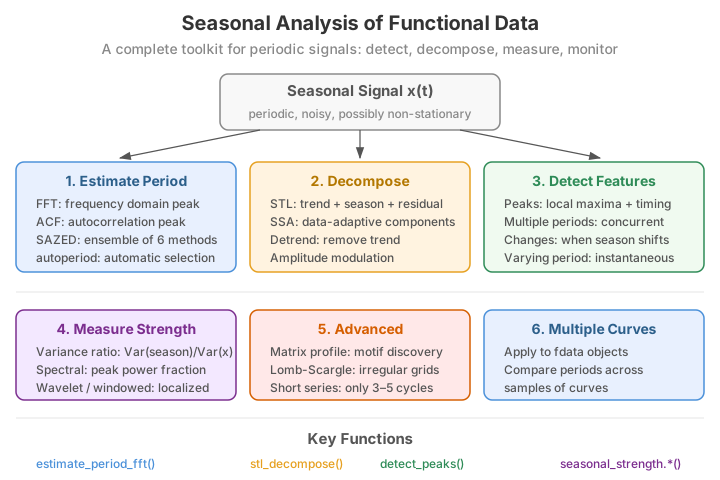
Many real-world functional datasets exhibit periodic patterns -- daily temperature cycles, weekly traffic flows, annual growth curves. The seasonal analysis module provides tools for detecting, decomposing, and measuring periodicity in functional data.
The periodogram: spectral view of a period
Every period-detection method here rests on the same idea: a periodic signal concentrates its energy at a single frequency (and its harmonics). For a centred, uniformly-sampled series \(x_0,\dots,x_{m-1}\) on a grid of spacing \(\Delta t\), the discrete Fourier transform is
and the periodogram is its squared magnitude,
The frequency \(\hat f = \arg\max_{f_k} I(f_k)\) that maximises spectral power gives the estimated
period \(\hat T = 1/\hat f\). estimate_period_fft does exactly this: it removes the mean, computes
\(I(f_k)\) with an FFT, and returns the peak. The reported confidence is the fraction of total
spectral power carried by the winning peak, \(I(\hat f)\big/\sum_k I(f_k)\) — a signal-to-noise
ratio in the frequency domain.
import numpy as np
from docs_fig import fig, render
from fdars.seasonal import estimate_period_fft

rng = np.random.default_rng(3)
t = np.linspace(0, 24, 720)
dt = t[1] - t[0]
# fundamental period 2.5 plus a weaker 2nd harmonic
x = np.sin(2 * np.pi * t / 2.5) + 0.4 * np.sin(2 * np.pi * t / 1.25)
X = x[None, :] + rng.normal(0, 0.25, (5, 720))

res = estimate_period_fft(X, t)

# periodogram of the (centred) sample mean, for display
xm = X.mean(0) - X.mean()
power = np.abs(np.fft.rfft(xm)) ** 2 / xm.size
freqs = np.fft.rfftfreq(xm.size, d=dt)
periods = np.divide(1.0, freqs, out=np.full_like(freqs, np.inf), where=freqs > 0)
keep = (periods > 0.5) & (periods < 6)

f, ax = fig(figsize=(7.4, 3.6))
ax.plot(periods[keep], power[keep], color="#3f51b5", lw=1.6)
ax.axvline(res["period"], color="#e8710a", ls="--", lw=1.5,
           label=f"peak $\\hat T$ = {res['period']:.3f}")
ax.axvline(2.5, color="#198754", ls=":", lw=1.4, label="true period 2.5")
ax.set(title="Periodogram: power vs. candidate period",
       xlabel="candidate period", ylabel="spectral power $I(f)$")
ax.legend()
print(render(f))
The dominant spike sits at the true period; the smaller companion at \(1.25\) is the second harmonic. Naive peak-picking can be fooled by such harmonics and by spectral leakage, which is why the algorithms below add validation steps (autocorrelation, clustering, gradient refinement) on top of the raw periodogram.
Period detection
fdars offers three period-detection algorithms, each with different strengths:
SAZED
SAZED (Seasonal And Zero-crossing Estimation of Periodicity via Distance) combines multiple period estimates from different signal features (zero crossings, peaks, autocorrelation) and returns a consensus period. The method is parameter-free by design: rather than trusting any single estimator, it forms an ensemble of periodicity cues and takes their agreement as the answer.
Two of the cues have simple closed forms. If a centred signal of length \(L\) (in time units) crosses zero \(Z\) times, a pure sinusoid crosses zero twice per cycle, so
A second cue comes from the (biased) sample autocorrelation
whose first prominent lag \(\tau^\star>0\) estimates the period, \(\hat T_{\text{acf}} = \tau^\star\,\Delta t\).
SAZED also draws a spectral estimate from the periodogram peak above. The consensus period is the
one to which the largest number of cues agree within the relative tolerance; confidence is that
count divided by the number of estimators (agreeing_components).
import numpy as np
from fdars import Fdata
from fdars.seasonal import sazed

argvals = np.linspace(0, 10, 500)
# Create data with a known period
fd = Fdata(
    np.sin(2 * np.pi * argvals / 2.5)[None, :] + np.random.default_rng(1).normal(0, 0.1, (10, 500)),
    argvals=argvals,
)

result = sazed(fd.data, fd.argvals, tolerance=0.05)
print(f"Detected period: {result['period']:.3f}")
print(f"Confidence:      {result['confidence']:.3f}")
print(f"Agreeing comps:  {result['agreeing_components']}")
Parameters
| Parameter | Type | Default | Description |
|---|---|---|---|
data |
ndarray (n, m) |
-- | Functional observations |
argvals |
ndarray (m,) |
-- | Evaluation points |
tolerance |
float |
0.05 |
Relative tolerance for period matching |
Returns a dictionary:
| Key | Type | Description |
|---|---|---|
period |
float |
Estimated period |
confidence |
float |
Confidence score (fraction of agreeing components) |
agreeing_components |
int |
Number of estimation methods that agree |
Autoperiod
Autoperiod (Vlachos, Yu & Castelli, 2005) is a two-stage estimator that pairs the frequency domain with the time domain to reject the spurious peaks a raw periodogram produces. Stage one scans the periodogram and keeps only candidate frequencies whose power exceeds a data-driven threshold — an "hint" set. Stage two validates each candidate \(T_c = 1/f_c\) against the autocorrelation \(\hat\rho(\tau)\): a genuine period sits on a hill (local maximum) of the ACF, whereas a leakage artefact does not. The surviving candidate is refined by gradient ascent on the ACF hill,
and the returned fft_power and acf_validation are the two evidence scores. Best for clean,
well-defined periodic signals.
from fdars.seasonal import autoperiod

result_ap = autoperiod(fd.data, fd.argvals, n_candidates=5, gradient_steps=10)
print(f"Period: {result_ap['period']:.3f}")
print(f"FFT power: {result_ap['fft_power']:.3f}")
print(f"ACF validation: {result_ap['acf_validation']:.3f}")
Parameters
| Parameter | Type | Default | Description |
|---|---|---|---|
data |
ndarray (n, m) |
-- | Functional observations |
argvals |
ndarray (m,) |
-- | Evaluation points |
n_candidates |
int |
5 |
Maximum number of FFT peaks to consider |
gradient_steps |
int |
10 |
Gradient ascent refinement steps |
Returns a dictionary:
| Key | Type | Description |
|---|---|---|
period |
float |
Estimated period |
confidence |
float |
Confidence score |
fft_power |
float |
Spectral power at the detected frequency |
acf_validation |
float |
Autocorrelation validation score |
CFD Autoperiod
CFD-Autoperiod (Puech et al., 2020) extends autoperiod to signals with several concurrent
cycles. It gathers many periodogram hints, then clusters the surviving candidates: periods
within the relative cluster_tolerance of one another are merged, and each cluster is represented
by its density-weighted centre. Clusters smaller than min_cluster_size are discarded as noise.
Because harmonics of a true period \(T\) appear near \(T, T/2, T/3,\dots\), clustering collapses a
harmonic family to one representative while genuinely distinct cycles survive as separate clusters
— returned in periods with their per-cluster confidences. Use it when you suspect, for example,
both a daily and a weekly rhythm in the same record.
from fdars.seasonal import cfd_autoperiod

result_cfd = cfd_autoperiod(fd.data, fd.argvals, cluster_tolerance=0.1, min_cluster_size=1)
print(f"Primary period: {result_cfd['period']:.3f}")
print(f"All periods:    {result_cfd['periods']}")
Parameters
| Parameter | Type | Default | Description |
|---|---|---|---|
data |
ndarray (n, m) |
-- | Functional observations |
argvals |
ndarray (m,) |
-- | Evaluation points |
cluster_tolerance |
float |
0.1 |
Tolerance for clustering candidate periods |
min_cluster_size |
int |
1 |
Minimum cluster size to keep |
Returns a dictionary:
| Key | Type | Description |
|---|---|---|
period |
float |
Primary (strongest) period |
confidence |
float |
Confidence for the primary period |
periods |
ndarray |
All detected periods |
confidences |
ndarray |
Confidence for each detected period |
Multiple periods by residual peeling
When several independent cycles coexist — say a fast and a slow rhythm — a single
peak is not enough. detect_multiple_periods (the R detect.periods) extracts them
one at a time: it finds the strongest sinusoid, subtracts its fitted contribution,
and repeats on the residual, so a strong cycle cannot mask a weaker co-existing one. It
returns a list of dicts, each with the extracted period, its confidence
(peak-to-mean spectral power), strength (variance explained), amplitude, phase,
and the iteration at which it was peeled off. Thresholds min_confidence and
min_strength stop the peeling once the residual is noise.
import numpy as np
from docs_fig import fig, render
from fdars.seasonal import detect_multiple_periods

rng = np.random.default_rng(3)
t = np.linspace(0, 48, 960)
# two genuinely distinct cycles (4 and 9 -- not harmonics of each other)
signal = np.sin(2 * np.pi * t / 4.0) + 0.7 * np.sin(2 * np.pi * t / 9.0)
X = signal[None, :] + rng.normal(0, 0.25, (6, 960))

found = detect_multiple_periods(X, t, max_periods=2, min_confidence=3.0, min_strength=0.15)
for r in found:
    print(f"iter {r['iteration']}: period={r['period']:.2f}  "
          f"strength={r['strength']:.2f}  amplitude={r['amplitude']:.2f}")

# periodogram of the sample mean, with the peeled periods marked
xm = X.mean(0) - X.mean()
dt = t[1] - t[0]
power = np.abs(np.fft.rfft(xm)) ** 2 / xm.size
freqs = np.fft.rfftfreq(xm.size, d=dt)
per = np.divide(1.0, freqs, out=np.full_like(freqs, np.inf), where=freqs > 0)
keep = (per > 2.0) & (per < 16.0)

f, ax = fig(figsize=(7.4, 3.6))
ax.plot(per[keep], power[keep], color="#3f51b5", lw=1.6)
for i, r in enumerate(found):
    ax.axvline(r["period"], color="#e8710a", ls="--", lw=1.5,
               label=f"peeled #{r['iteration']}: T={r['period']:.2f}")
for pt, c in ((4.0, "#198754"), (9.0, "#198754")):
    ax.axvline(pt, color=c, ls=":", lw=1.2)
ax.set(title="detect_multiple_periods: residual peeling recovers both cycles",
       xlabel="candidate period", ylabel="spectral power $I(f)$")
ax.legend()
print(render(f))
The two dashed lines sit on (or, for the longer period, within one FFT bin of) the two dotted true periods (4 and 9): the first pass peels the dominant period-4 cycle, and the second recovers the weaker period-9 one from the residual — a cycle that a single-peak detector, dominated by the period-4 spike, would have missed.
Lomb–Scargle periodogram
The classical periodogram assumes a perfectly uniform grid. The Lomb–Scargle periodogram (Lomb, 1976; Scargle, 1982) generalises it to unevenly sampled data by fitting a sinusoid \(a\cos(2\pi f t)+b\sin(2\pi f t)\) at each trial frequency by least squares. With a time offset \(\tau\) chosen per frequency so the estimator is time-shift invariant,
the normalised power is
A tall, isolated peak in \(P_{\mathrm{LS}}\) marks the dominant period. Under the null hypothesis of Gaussian noise, a single power value has an exponential distribution, so the false-alarm probability for the highest of \(N_{\text{eff}}\) independent frequencies is approximately
which lomb_scargle_fdata returns as false_alarm_probability (and significance \(=1-\mathrm{FAP}\)).
oversampling controls the frequency grid density; nyquist_factor how far past the pseudo-Nyquist
frequency to search.
import numpy as np
from docs_fig import fig, render
from fdars.seasonal import lomb_scargle_fdata

rng = np.random.default_rng(7)
t = np.linspace(0, 30, 600)
X = np.sin(2 * np.pi * t / 3.0)[None, :] + rng.normal(0, 0.4, (6, 600))

ls = lomb_scargle_fdata(X, t)
per = np.asarray(ls["periods"])
pw = np.asarray(ls["power"])
keep = (per > 1.0) & (per < 8.0)

f, ax = fig(figsize=(7.4, 3.6))
ax.plot(per[keep], pw[keep], color="#6f42c1", lw=1.5)
ax.axvline(ls["peak_period"], color="#e8710a", ls="--", lw=1.5,
           label=f"peak $T$ = {ls['peak_period']:.2f}  (FAP {ls['false_alarm_probability']:.1e})")
ax.set(title="Lomb–Scargle periodogram",
       xlabel="candidate period", ylabel="normalised power $P_{LS}$")
ax.legend()
print(render(f))
The periodogram shows a single dominant spike at the peak period, and its very small false-alarm probability marks that peak as a genuine cycle rather than a noise artefact -- a principled significance test to accompany the visual peak.
Uniform grids too
fdars samples functional data on a common grid, so Lomb–Scargle here mostly serves as a
robust cross-check on estimate_period_fft and a principled significance test (the FAP). Its
real advantage — gappy or irregular sampling — appears once you feed it a non-uniform
argvals.
Matrix profile
The matrix profile (Yeh et al., 2016) is a time-series primitive that, for every length-\(w\) window \(x_{i:i+w}\) of the series, stores the z-normalised Euclidean distance to its nearest non-trivial neighbour elsewhere in the series:
where \(\hat a = (a-\bar a)/\sigma_a\) is the z-normalisation. A window that repeats every \(T\) points
finds a near-duplicate a distance \(T\) away, so the profile-index — the arg-min \(j\) — differs
from \(i\) by a near-constant \(\approx T\) across a periodic stretch. matrix_profile_fdata mines
those index differences into detected_periods (in grid points) and a primary_period; low
matrix-profile values also flag motifs (repeated shapes), high values flag discords (anomalies).
subsequence_length sets \(w\); exclusion_zone the trivial-match guard band.
import numpy as np
from docs_fig import fig, render
from fdars.seasonal import matrix_profile_fdata

rng = np.random.default_rng(11)
t = np.linspace(0, 24, 720)
dt = t[1] - t[0]
x = np.sin(2 * np.pi * t / 3.0) + rng.normal(0, 0.08, 720)
x[360:400] += 2.5                    # inject a discord (a bump that breaks the cycle)
X = x[None, :]

w = int(round(3.0 / dt))              # one period per window
mp = matrix_profile_fdata(X, subsequence_length=w)
prof = np.asarray(mp["profile"])
prim_pts = mp["primary_period"]
print(f"primary period: {prim_pts * dt:.2f} time units  (true 3.0)")

f, (a0, a1) = fig(2, 1, figsize=(7.8, 4.6), sharex=False)
a0.plot(t, X[0], color="#3f51b5", lw=0.9)
a0.axvspan(t[360], t[399], color="#dc3545", alpha=0.15)
a0.set(ylabel="signal", title="Matrix profile of a periodic curve with one discord")
a1.plot(prof, color="#198754", lw=1.0)
a1.axvline(int(np.argmax(prof)), color="#dc3545", ls="--", lw=1.4,
           label=f"discord at window {int(np.argmax(prof))}")
a1.set(xlabel="window index $i$", ylabel="MP[$i$]")
a1.legend()
print(render(f))
The matrix profile stays low across the periodic body — every window there has a close
repeat one period away — and spikes sharply at the injected discord (shaded), where no
window elsewhere matches. That tall spike, well above the periodic baseline, is exactly
how the matrix profile localises anomalies, while the recovered primary_period confirms
the underlying cycle. It is a robust, largely parameter-free companion to spectral period
detection.
Singular Spectrum Analysis (SSA)
SSA (Golyandina, Nekrutkin & Zhigljavsky, 2001) is a non-parametric decomposition that needs no prior period. It embeds the series into a trajectory matrix of lagged windows,
takes its singular value decomposition \(\mathbf{H}=\sum_i \sqrt{\lambda_i}\,u_i v_i^{\top}\), and
groups the rank-one terms into interpretable components before diagonal averaging
(Hankelisation) turns each group back into a series. Trend components carry the largest singular
values; an oscillation appears as a pair of adjacent singular values with in-quadrature
eigenvectors. ssa_fdata returns trend, seasonal, and noise series plus the
singular_values and their normalised contributions \(\lambda_i/\sum_j \lambda_j\); window_length
is \(L\) and n_components how many leading terms to keep.
import numpy as np
from docs_fig import fig, render
from fdars.seasonal import ssa_fdata

rng = np.random.default_rng(2)
t = np.linspace(0, 20, 600)
# A linear trend plus a fast oscillation (period 0.4). Keeping the period short
# relative to the SSA window lets the auto-grouping cleanly separate the smooth
# ramp (trend) from the oscillatory pair (seasonal).
X = (0.1 * t + np.sin(2 * np.pi * t / 0.4))[None, :] + rng.normal(0, 0.15, (4, 600))

d = ssa_fdata(X, window_length=120, n_components=6)
trend = np.asarray(d["trend"])
seasonal = np.asarray(d["seasonal"])
contrib = np.asarray(d["contributions"])

f, (a0, a1) = fig(1, 2, figsize=(8.6, 3.4))
a0.plot(t, X[0], color="#6c757d", lw=0.7, label="signal")
a0.plot(t, trend, color="#e8710a", lw=1.8, label="SSA trend")
a0.plot(t, seasonal, color="#198754", lw=1.2, label="SSA seasonal")
a0.set(xlabel="t", title="SSA reconstruction")
a0.legend(fontsize=8)
a1.bar(np.arange(contrib.size), contrib, color="#3f51b5")
a1.set(xlabel="component", ylabel="variance share",
       title="Singular-value contributions")
print(render(f))
The two leading components recover the trend and the oscillation; their singular-value shares show how much variance each explains — a scree-style diagnostic for how many components to retain.
Peak detection
Locate peaks in each functional observation, optionally smoothing the data first. The function also estimates the mean period from inter-peak distances.
from fdars.seasonal import detect_peaks

peaks = detect_peaks(
    fd.data, fd.argvals,
    min_distance=0.5,
    min_prominence=0.1,
    smooth_first=True,
    smooth_nbasis=20,
)
print(f"Mean period from peaks: {peaks['mean_period']:.3f}")

# Peaks for the first observation: list of (time, value, prominence) tuples
for t, v, p in peaks["peaks"][0]:
    print(f"  t={t:.2f}  value={v:.3f}  prominence={p:.3f}")
Parameters
| Parameter | Type | Default | Description |
|---|---|---|---|
data |
ndarray (n, m) |
-- | Functional observations |
argvals |
ndarray (m,) |
-- | Evaluation grid |
min_distance |
float |
None |
Minimum distance between consecutive peaks |
min_prominence |
float |
None |
Minimum peak prominence |
smooth_first |
bool |
False |
Smooth data before detection |
smooth_nbasis |
int |
None |
Number of basis functions for smoothing |
Returns a dictionary:
| Key | Type | Description |
|---|---|---|
peaks |
list[list[tuple]] |
Per-observation list of (time, value, prominence) tuples |
mean_period |
float |
Mean inter-peak distance across all observations |
STL decomposition
STL (Cleveland et al., 1990) splits each observation into an additive sum
a trend \(T_n\), a seasonal \(S_n\) of the given period, and a remainder \(R_n\). It is an
iterative procedure built entirely from Loess smoothers. Each pass runs an inner loop that
(i) detrends, \(x_n - T_n\); (ii) Loess-smooths the detrended values cycle-subseries by
cycle-subseries to update the seasonal \(S_n\); (iii) low-pass filters and subtracts that to keep
\(S_n\) mean-free; and (iv) Loess-smooths the deseasonalised series \(x_n - S_n\) to update \(T_n\). When
robust=True, an outer loop re-weights each point by
so large residuals (the bisquare \(B\)) stop distorting the fit — useful when the record contains
spikes. s_window and t_window set the seasonal and trend Loess spans.
from fdars.seasonal import stl_decompose

decomp = stl_decompose(fd.data, period=25, robust=False)
# decomp["trend"]     shape (n, m)
# decomp["seasonal"]  shape (n, m)
# decomp["remainder"] shape (n, m)
Parameters
| Parameter | Type | Default | Description |
|---|---|---|---|
data |
ndarray (n, m) |
-- | Functional observations |
period |
int |
-- | Seasonal period (in grid points) |
s_window |
int |
None |
Seasonal smoothing window (auto if None) |
t_window |
int |
None |
Trend smoothing window (auto if None) |
robust |
bool |
False |
Use robust (re-weighted) fitting |
Returns a dictionary:
| Key | Shape | Description |
|---|---|---|
trend |
(n, m) |
Trend component |
seasonal |
(n, m) |
Seasonal component |
remainder |
(n, m) |
Remainder (residual) |
Seasonal strength
Quantify how strongly seasonal a signal is, using either a variance-based or spectral method. The returned value lies in \([0, 1]\), where 0 means no seasonality and 1 means a purely periodic signal.
The variance method follows the STL-based strength of Wang, Smith & Hyndman (2006): after decomposing \(x = T + S + R\), the seasonal strength compares the variance the seasonal component removes against the variance left in the remainder,
If the seasonal component explains most of the deseasonalised variance, \(\operatorname{Var}(R)\) is small and \(F_S \to 1\); if it explains nothing, \(\operatorname{Var}(R)\approx\operatorname{Var}(S+R)\) and \(F_S \to 0\). The spectral method instead measures the share of periodogram power that falls in a band around the fundamental frequency \(f_0 = 1/T\) and its harmonics,
from fdars.seasonal import seasonal_strength

strength = seasonal_strength(fd.data, fd.argvals, period=2.5, method="variance")
print(f"Seasonal strength (variance): {strength:.3f}")

strength_spec = seasonal_strength(fd.data, fd.argvals, period=2.5, method="spectral")
print(f"Seasonal strength (spectral): {strength_spec:.3f}")
Parameters
| Parameter | Type | Default | Description |
|---|---|---|---|
data |
ndarray (n, m) |
-- | Functional observations |
argvals |
ndarray (m,) |
-- | Evaluation points |
period |
float |
-- | Estimated period |
method |
str |
"variance" |
"variance" or "spectral" |
Returns a float -- the seasonal strength.
Scanning the candidate period reveals sharp peaks at the true period and its harmonics, which is exactly how period-detection methods locate the dominant cycle.
Seasonal strength peaks sharply at the true period of 2.0 and decays for mismatched candidates, so scanning the period axis and taking the arg-max is itself a viable period-detection strategy that doubles as a confidence diagnostic.
Detrend first: trends mask seasonality
A strong trend swamps the periodic component: period detection returns the series length
(or nan) and seasonal strength collapses to near zero. Detrend before analysing. The
current Python build has no packaged detrend, so we remove a linear trend by hand with a
least-squares fit -- after which the period and strength are recovered.
import numpy as np
from fdars.seasonal import sazed, seasonal_strength

rng = np.random.default_rng(1)
t = np.linspace(0, 20, 400)
X = 5 + 2 * t + np.sin(2 * np.pi * t / 2.5) + rng.normal(0, 0.3, t.size)  # strong trend

# Without detrending: period and strength are wrong
p_raw = sazed(X[None, :], t)["period"]
s_raw = seasonal_strength(X[None, :], t, period=2.5, method="variance")
print(f"With trend   -> period={p_raw:.3f} (true 2.5), strength={s_raw:.3f}")

# Manual linear detrend: subtract the least-squares line
A = np.vstack([t, np.ones_like(t)]).T
X_det = X - A @ np.linalg.lstsq(A, X, rcond=None)[0]

p_det = sazed(X_det[None, :], t)["period"]
s_det = seasonal_strength(X_det[None, :], t, period=2.5, method="variance")
print(f"Detrended    -> period={p_det:.3f} (true 2.5), strength={s_det:.3f}")
With trend -> period=nan (true 2.5), strength=0.005 Detrended -> period=2.503 (true 2.5), strength=0.863
With the trend in place the period estimate is badly off and the strength near zero; after the manual linear detrend both snap back to the true period of 2.5 with a clearly non-zero strength -- a direct demonstration that trend removal is a prerequisite, not an optional polish.
No packaged detrend binding
The R reference ships a detrend() helper (linear / polynomial / LOESS / differencing
/ auto) and a detrend_method argument on many functions. Those are not exposed in
the current Python build. Detrend manually (a least-squares line as above, a polynomial
fit, or first differences) before calling the seasonal routines when a trend is present.
Time-varying seasonal strength
For a long record whose periodicity switches on or off, a single strength number is
misleading. seasonal_strength_windowed slides a window along the series and reports the
local strength, exposing exactly when the seasonality appears or vanishes.
import numpy as np
from docs_fig import fig, render
from fdars.seasonal import seasonal_strength_windowed

rng = np.random.default_rng(1)
t = np.linspace(0, 40, 800)
# Seasonal for t < 20, then pure noise
X = np.where(t < 20,
             np.sin(2 * np.pi * t / 2.5) + rng.normal(0, 0.2, t.size),
             rng.normal(0, 0.5, t.size))

strength = np.asarray(
    seasonal_strength_windowed(X[None, :], t, period=2.5, window_size=10.0, method="variance"))

f, (a0, a1) = fig(2, 1, figsize=(8.0, 4.6), sharex=True)
a0.plot(t, X, color="#6c757d", lw=0.7)
a0.axvline(20, color="#dc3545", ls="--", lw=1.4)
a0.set(ylabel="signal", title="Seasonality stops at t = 20")
a1.plot(t, strength, color="#3f51b5", lw=1.8)
a1.axvline(20, color="#dc3545", ls="--", lw=1.4, label="cessation")
a1.set(xlabel="t", ylabel="seasonal strength", ylim=(0, 1.02))
a1.legend()
print(render(f))
The strength curve stays high while the sinusoid is present and drops sharply once the signal becomes noise -- a direct read-out of when seasonality is active.
Classifying the seasonality
classify_seasonality combines seasonal strength with peak-timing variability to label a
series as StableSeasonal, VariableTiming, IntermittentSeasonal, or NonSeasonal.
import numpy as np
from fdars.seasonal import classify_seasonality

rng = np.random.default_rng(0)
t = np.linspace(0, 20, 400)

signals = {
    "clean sinusoid": np.sin(2 * np.pi * t / 2.0) + rng.normal(0, 0.05, t.size),
    "half seasonal":  0.5 * np.sin(2 * np.pi * t / 2.0) + 0.5 * rng.normal(0, 1, t.size),
    "pure noise":     rng.normal(0, 1, t.size),
}

for name, X in signals.items():
    r = classify_seasonality(X[None, :], t, period=2.0)
    print(f"{name:15s} -> {r['classification']:20s} "
          f"strength={r['seasonal_strength']:.2f}  seasonal={r['is_seasonal']}")
clean sinusoid -> StableSeasonal strength=1.00 seasonal=True half seasonal -> StableSeasonal strength=0.37 seasonal=True pure noise -> NonSeasonal strength=0.02 seasonal=False
The returned dictionary also carries timing_variability, has_stable_timing, and
per-cycle cycle_strengths, so you can dig into why a series earned its label. For the
raw timing analysis alone, analyze_peak_timing reports the mean, spread, and trend of
peak positions across cycles; for smoothly drifting frequencies, instantaneous_period
returns a Hilbert-based period at every time point (unreliable near the series ends).
Full example -- detect period, decompose, and measure strength
import numpy as np
from fdars import Fdata
from fdars.seasonal import sazed, stl_decompose, seasonal_strength, detect_peaks

# ── 1. Create seasonal data ──────────────────────────────────
rng = np.random.default_rng(42)
argvals = np.linspace(0, 20, 1000)
trend = 0.05 * argvals
seasonal = np.sin(2 * np.pi * argvals / 4.0)
fd = Fdata(
    (trend + seasonal)[None, :] + rng.normal(0, 0.15, (15, 1000)),
    argvals=argvals,
)

# ── 2. Detect the period ─────────────────────────────────────
detected = sazed(fd.data, fd.argvals)
print(f"Detected period: {detected['period']:.2f}  (true = 4.0)")

# ── 3. Decompose ─────────────────────────────────────────────
period_pts = int(round(detected["period"] / (fd.argvals[1] - fd.argvals[0])))
decomp = stl_decompose(fd.data, period=period_pts)
print(f"Trend range:     [{decomp['trend'][0].min():.2f}, {decomp['trend'][0].max():.2f}]")
print(f"Seasonal range:  [{decomp['seasonal'][0].min():.2f}, {decomp['seasonal'][0].max():.2f}]")

# ── 4. Measure strength ──────────────────────────────────────
s = seasonal_strength(fd.data, fd.argvals, period=detected["period"])
print(f"Seasonal strength: {s:.3f}")

# ── 5. Find peaks ────────────────────────────────────────────
pk = detect_peaks(fd.data, fd.argvals, smooth_first=True, smooth_nbasis=30)
print(f"Mean inter-peak distance: {pk['mean_period']:.2f}")
References
- Cleveland, R. B., Cleveland, W. S., McRae, J. E., & Terpenning, I. (1990). STL: A Seasonal-Trend Decomposition Procedure Based on Loess. Journal of Official Statistics, 6(1), 3–73.
- Golyandina, N., Nekrutkin, V., & Zhigljavsky, A. (2001). Analysis of Time Series Structure: SSA and Related Techniques. Chapman & Hall/CRC.
- Lomb, N. R. (1976). Least-squares frequency analysis of unequally spaced data. Astrophysics and Space Science, 39(2), 447–462.
- Puech, T., Boussard, M., D'Amato, A., & Millerand, G. (2020). A fully automated periodicity detection in time series. In Advanced Analytics and Learning on Temporal Data (AALTD), LNCS 11986, Springer, 43–54.
- Scargle, J. D. (1982). Studies in astronomical time series analysis. II. Statistical aspects of spectral analysis of unevenly spaced data. The Astrophysical Journal, 263, 835–853.
- Toller, M., Santos, T., & Kern, R. (2019). SAZED: parameter-free domain-agnostic season length estimation in time series data. Data Mining and Knowledge Discovery, 33(6), 1775–1798.
- Vlachos, M., Yu, P., & Castelli, V. (2005). On periodicity detection and structural periodic similarity. In Proceedings of the 2005 SIAM International Conference on Data Mining, 449–460.
- Wang, X., Smith, K., & Hyndman, R. (2006). Characteristic-based clustering for time series data. Data Mining and Knowledge Discovery, 13(3), 335–364.
- Yeh, C.-C. M., et al. (2016). Matrix profile I: All pairs similarity joins for time series. In IEEE International Conference on Data Mining (ICDM), 1317–1322.
See also
- Covariance functions -- the second-order structure of a functional sample, complementary to the periodic structure analysed here.
fdars.basis-- Fourier bases for smoothing periodic signals before peak detection.