Scalar-on-Function Regression
Scalar-on-function regression predicts a scalar response \(y_i\) from a functional predictor \(x_i(t)\) through the functional linear model:
The coefficient function \(\beta(t)\) is the object of interest: it reveals which
regions of the predictor curve drive the response. fdars provides several
complementary estimators for this model.
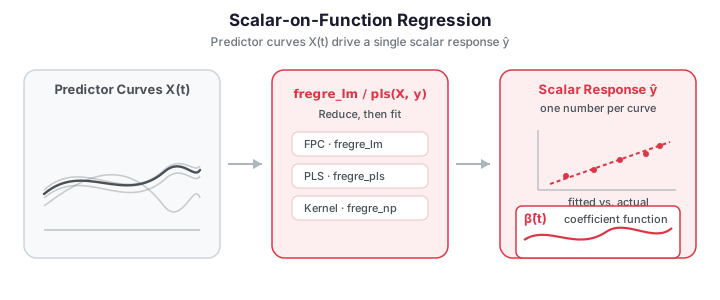
The estimation challenge
Estimating \(\beta(t)\) directly is ill-posed. Discretising the predictor on \(m\) grid points turns the integral into an \(m\)-dimensional regression, and with \(m \gg n\) the least-squares problem is massively overparameterised. Every practical method therefore reduces dimensionality before fitting, and they differ in how:
| Method | fdars function |
Key parameter | Idea |
|---|---|---|---|
| FPC regression | fregre_lm |
n_comp |
project onto principal components |
| PLS regression | fregre_pls |
n_comp |
components chosen to predict \(y\) |
| Nonparametric | fregre_np |
h (bandwidth) |
kernel-smooth over a distance matrix |
| Robust FPC | fregre_huber, fregre_l1 |
n_comp |
down-weight outliers |
Quick rule: start with fregre_lm (FPC regression) — it is fast, gives an
interpretable \(\hat\beta(t)\), and returns the fitted values and \(R^2\) you need
for diagnostics. Switch to fregre_np if you suspect the \(x \mapsto y\)
relationship is nonlinear, and to the robust variants if outliers are present.
The two figures below show what a fitted model produces: the recovered coefficient function \(\hat\beta(t)\) (compared against the truth) and a predicted-vs-actual scatter of the scalar response.
The points cluster tightly along the dashed identity line, so the four-component FPC fit recovers most of the response variance — the reported \(R^2\) quantifies exactly how much. Scatter about the diagonal is the irreducible noise we injected, a reminder that a scalar-on-function model can only explain the part of \(y\) that is linearly encoded in the curve shape.
1. FPC regression
The most common approach: expand the coefficient function in the eigenbasis \(\{\phi_k\}\) of the predictor's covariance operator, \(\beta(t) = \sum_k \gamma_k \phi_k(t)\). Writing the FPC scores as \(\xi_{ik} = \int (x_i(t) - \bar x(t))\,\phi_k(t)\,dt\), the model collapses to an ordinary linear regression on the first \(K\) scores,
and the coefficient function is reconstructed as \(\hat\beta(t) = \sum_{k=1}^{K}\hat\gamma_k\,\phi_k(t)\).
import numpy as np
from fdars import Fdata
from fdars.regression import fregre_lm

# Simulate data
np.random.seed(42)
n, m = 100, 81
t = np.linspace(0, 1, m)
beta_true = np.sin(4 * np.pi * t)

# Generate functional predictors (smooth random curves)
raw = np.zeros((n, m))
for i in range(n):
    raw[i] = (
        np.random.randn() * np.sin(2 * np.pi * t)
        + np.random.randn() * np.cos(2 * np.pi * t)
        + np.random.randn() * np.sin(4 * np.pi * t)
        + 0.3 * np.random.randn(m)
    )
fd = Fdata(raw, argvals=t)

# Scalar response = integral of data * beta + noise
response = np.trapezoid(fd.data * beta_true, fd.argvals, axis=1) + 0.5 * np.random.randn(n)

# Fit the model
result = fregre_lm(fd.data, response, n_comp=3)

fitted   = result["fitted_values"]   # (n,)
resid    = result["residuals"]       # (n,)
beta_hat = result["beta_t"]          # (m,) -- estimated beta(t)
r2       = result["r_squared"]       # scalar
coefs    = result["coefficients"]    # FPC coefficients
intercept = result["intercept"]      # scalar

print(f"R-squared: {r2:.4f}")
| Key | Type | Description |
|---|---|---|
fitted_values |
ndarray (n,) |
Predicted response values |
residuals |
ndarray (n,) |
Residuals \(y - \hat{y}\) |
beta_t |
ndarray (m,) |
Estimated coefficient function \(\hat{\beta}(t)\) |
r_squared |
float |
Coefficient of determination |
coefficients |
ndarray (k,) |
Regression coefficients on FPC scores |
intercept |
float |
Intercept \(\hat{\alpha}\) |
Number of components
The choice of n_comp controls the bias-variance trade-off. Too few
components under-fit; too many over-fit. Use fregre_cv (Section 4) or
model_selection_ncomp (Section 5) for automatic selection.
2. PLS regression
Partial Least Squares finds components that maximise the covariance between the functional predictor and the response, often out-performing FPCA when the dominant modes of variation are not the most predictive.
from fdars.regression import fregre_pls

result = fregre_pls(fd.data, fd.argvals, response, n_comp=3)

print(f"PLS R-squared: {result['r_squared']:.4f}")
print(f"Beta shape:    {np.asarray(result['beta_t']).shape}")
| Key | Type | Description |
|---|---|---|
fitted_values |
ndarray (n,) |
Fitted values |
residuals |
ndarray (n,) |
Residuals |
beta_t |
ndarray (m,) |
PLS coefficient function |
r_squared |
float |
\(R^2\) |
PLS vs. FPC regression
PLS is preferable when the response depends on modes of variation with small eigenvalues. FPC regression may miss these because FPCA is unsupervised — it picks the directions of largest variance, not largest covariance with \(y\).
Keep the PLS component count small
fregre_pls reaches the predictive signal in very few supervised components.
Asking for more than the data support can make the reconstructed
\(\hat\beta(t)\) oscillate wildly even when the fitted \(R^2\) looks fine, so
always pick n_comp by cross-validation (Section 4) and prefer the smallest
count that captures the signal — two components suffice in the example above.
3. Nonparametric regression
When the relationship between \(x(t)\) and \(y\) is nonlinear, use a Nadaraya–Watson kernel estimator built on a pre-computed distance matrix. For a query curve \(x^\*\),
where \(d(\cdot,\cdot)\) is any functional distance and \(h\) is the bandwidth. This makes no linearity assumption; the choice of distance sets the geometry.
from fdars.regression import fregre_np
from fdars.metric import lp_self_1d

# Compute L2 distance matrix
D = lp_self_1d(fd.data, fd.argvals, p=2.0)

result = fregre_np(D, response, h=0.0)  # h=0.0 -> automatic bandwidth

print(f"NP R-squared: {result['r_squared']:.4f}")
print(f"Bandwidth:    {result['h_func']:.4f}")
| Key | Type | Description |
|---|---|---|
fitted_values |
ndarray (n,) |
Fitted values |
residuals |
ndarray (n,) |
Residuals |
h_func |
float |
Selected or user-specified bandwidth |
r_squared |
float |
\(R^2\) |
Distance choice matters
The distance metric used to build D determines the geometry of the
regression. Swap \(L^2\) for an elastic, DTW, or Fourier distance
(fdars.metric) to match the structure of your curves.
4. Cross-validating the number of components
fregre_cv runs \(k\)-fold cross-validation over a range of FPC component counts
and returns the value of \(K\) minimising out-of-fold error, together with the
per-\(k\) curve you can plot.
from fdars.regression import fregre_cv

cv = fregre_cv(fd.data, response, k_min=1, k_max=8, n_folds=5)
print(f"Optimal number of components: {cv['optimal_k']}")
| Key | Type | Description |
|---|---|---|
optimal_k |
int |
Component count with lowest CV error |
k_values |
ndarray |
The \(K\) values tested |
cv_errors |
ndarray |
Mean CV error for each \(K\) |
min_cv_error |
float |
Error at optimal_k |
oof_predictions |
ndarray (n,) |
Out-of-fold predictions at optimal_k |
fold_errors |
ndarray |
Error per fold |
fold_assignments |
ndarray (n,) |
Fold index of each observation |
The figure below plots the CV curve; the marked minimum is the selected \(K\).
import numpy as np
from docs_fig import fig, render
from fdars import Fdata
from fdars.regression import fregre_cv

np.random.seed(7)
n, m = 90, 81
t = np.linspace(0, 1, m)
beta_true = np.sin(4 * np.pi * t)
raw = np.zeros((n, m))
for i in range(n):
    raw[i] = (np.random.randn() * np.sin(2 * np.pi * t)
              + np.random.randn() * np.cos(2 * np.pi * t)
              + np.random.randn() * np.sin(4 * np.pi * t)
              + 0.3 * np.random.randn(m))
fd = Fdata(raw, argvals=t)
y = np.trapezoid(fd.data * beta_true, fd.argvals, axis=1) + 0.5 * np.random.randn(n)

cv = fregre_cv(fd.data, y, k_min=1, k_max=10, n_folds=5)
ks = np.asarray(cv["k_values"])
errs = np.asarray(cv["cv_errors"])
best = int(cv["optimal_k"])

f, ax = fig()
ax.plot(ks, errs, "-o", color="#3f51b5")
ax.axvline(best, color="#e8710a", ls="--", lw=1.5, label=f"optimal K = {best}")
ax.set(title="Cross-validated component selection",
       xlabel="number of FPC components K", ylabel="CV error")
ax.legend()
print(render(f))
The CV curve drops sharply as the first few components enter, then flattens and eventually rises — the classic bias-variance U-shape. The orange line marks the \(K\) that minimizes held-out error, and choosing it avoids both underfitting (too few components) and the variance inflation that comes from padding the model with noise-dominated eigenfunctions.
5. Model selection by information criteria
Where fregre_cv uses out-of-sample error, model_selection_ncomp scores each
candidate \(K\) with in-sample AIC, BIC, or GCV — cheaper, and useful
when you want to compare criteria side by side.
from fdars.regression import model_selection_ncomp

result = model_selection_ncomp(fd.data, response, max_comp=10, criterion="gcv")

best_k = result["best_ncomp"]
print(f"Best number of components: {best_k}")

# Inspect all criteria
for ncomp, aic, bic, gcv in result["criteria"]:
    print(f"  k={ncomp}: AIC={aic:.2f}, BIC={bic:.2f}, GCV={gcv:.4f}")
| Key | Type | Description |
|---|---|---|
best_ncomp |
int |
Optimal number of components |
criteria |
list[tuple] |
(ncomp, AIC, BIC, GCV) for each \(K\) tested |
6. Robust regression
When a few curves or responses are contaminated, ordinary FPC regression can be
badly distorted. fregre_huber replaces the squared loss with Huber's loss
(quadratic near zero, linear in the tails), and fregre_l1 uses least-absolute
deviations. Both share the FPC dimension reduction of fregre_lm.
from fdars.regression import fregre_huber, fregre_l1

hub = fregre_huber(fd.data, response, n_comp=3, huber_k=1.345)
l1  = fregre_l1(fd.data, response, n_comp=3)

print("Huber beta shape:", np.asarray(hub["beta_t"]).shape)
print("L1 beta shape:   ", np.asarray(l1["beta_t"]).shape)
Both return fitted_values, residuals, and beta_t. Use them as drop-in
replacements for fregre_lm when a residual or QQ plot flags outliers.
7. FPCA-then-regression pattern
For maximum control, run FPCA explicitly and feed the scores into your own regression pipeline.
from fdars.regression import fpca
import numpy as np

# Step 1: FPCA
pca = fpca(fd.data, fd.argvals, n_comp=5)
scores   = np.asarray(pca["scores"])     # (n, 5)
rotation = np.asarray(pca["rotation"])   # (m, 5)
mean_fn  = np.asarray(pca["mean"])       # (m,)

# Step 2: OLS on the scores (using numpy)
X = np.column_stack([np.ones(n), scores])
beta_hat = np.linalg.lstsq(X, response, rcond=None)[0]
fitted = X @ beta_hat
r2 = 1 - np.sum((response - fitted)**2) / np.sum((response - response.mean())**2)
print(f"Manual FPC regression R-squared: {r2:.4f}")

# Step 3: Reconstruct beta(t) in function space
beta_t = rotation @ beta_hat[1:]
Methods available in the R package but not (yet) in Python
The R reference also documents fregre.basis (basis-expansion regression
with a roughness penalty), a pure-R fregre.pc, and the flm.test
linearity test. These have no fdars Python binding today, so they are
omitted here rather than faked. The FPCA-then-regression pattern above
covers the fregre.pc case; for a basis expansion, fit a basis with
fdars.basis and regress on the coefficients yourself.
Diagnostics: residuals and coefficient recovery
After fitting, two plots tell you most of what you need. A fitted-vs-residual plot checks for constant variance (a random band around zero is good; a fan or curve is not), and overlaying \(\hat\beta(t)\) on the truth shows how faithfully the model recovered the signal.
import numpy as np
from docs_fig import fig, render
from fdars import Fdata
from fdars.regression import fregre_lm

np.random.seed(11)
n, m = 100, 81
t = np.linspace(0, 1, m)
beta_true = np.sin(4 * np.pi * t)
raw = np.zeros((n, m))
for i in range(n):
    raw[i] = (np.random.randn() * np.sin(2 * np.pi * t)
              + np.random.randn() * np.cos(2 * np.pi * t)
              + np.random.randn() * np.sin(4 * np.pi * t)
              + 0.3 * np.random.randn(m))
fd = Fdata(raw, argvals=t)
y = np.trapezoid(fd.data * beta_true, fd.argvals, axis=1) + 0.5 * np.random.randn(n)

lm = fregre_lm(fd.data, y, n_comp=3)   # the signal lives in the first 3 modes; more over-fits
fitted = np.asarray(lm["fitted_values"])
resid = np.asarray(lm["residuals"])

f, (a0, a1) = fig(1, 2, figsize=(11, 4))
a0.scatter(fitted, resid, color="#3f51b5", s=24, alpha=0.7)
a0.axhline(0, color="#6c757d", ls="--", lw=1.5)
a0.set(title="Fitted vs residuals", xlabel="fitted", ylabel="residual")

a1.plot(t, beta_true, color="#6c757d", lw=2, ls="--", label=r"true $\beta(t)$")
a1.plot(t, np.asarray(lm["beta_t"]), color="#3f51b5", lw=2, label="estimate")
a1.set(title="Coefficient recovery", xlabel="t", ylabel=r"$\beta(t)$")
a1.legend()
print(render(f))
The left panel shows residuals scattered in a structureless band around zero, with no funnel or curvature — the linear FPC model is well-specified and its errors are homoscedastic. The right panel confirms the estimated coefficient function (blue) tracks the true \(\beta(t)\) (dashed) closely, so the fitted model is not just predictive but also recovers the interpretable weight profile that generated the data.
Comparing methods on a hold-out set
The honest way to choose a method is out-of-sample error. Below we split the data, fit FPC, PLS, and nonparametric models on the training set, predict the test responses, and tabulate RMSE / \(R^2\) / MAE.
import numpy as np
from docs_fig import fig, render
from fdars import Fdata
from fdars.regression import (
    fregre_lm, fregre_pls, fregre_np,
    predict_fregre_lm, predict_fregre_pls,
)
from fdars.metric import lp_self_1d, lp_cross_1d

np.random.seed(99)
n, m = 140, 101
t = np.linspace(0, 1, m)
# Coefficient concentrated in the late part of the domain
beta_true = np.where(t > 0.6, 5 * (t - 0.6), 0.0)

raw = np.zeros((n, m))
for i in range(n):
    c1, c2, c3 = np.random.randn(3)
    raw[i] = c1 * t + c2 * t**2 + c3 * np.sin(np.pi * t) + 0.2 * np.random.randn(m)
fd = Fdata(raw, argvals=t)
y = np.trapezoid(fd.data * beta_true, fd.argvals, axis=1) + 0.3 * np.random.randn(n)

ntr = 100
Xtr, ytr = fd.data[:ntr], y[:ntr]
Xte, yte = fd.data[ntr:], y[ntr:]

def metrics(y_true, y_pred):
    y_true, y_pred = np.asarray(y_true), np.asarray(y_pred)
    err = y_true - y_pred
    rmse = np.sqrt(np.mean(err**2))
    mae = np.mean(np.abs(err))
    r2 = 1 - np.sum(err**2) / np.sum((y_true - y_true.mean())**2)
    return rmse, r2, mae

# FPC and PLS have proper predict functions
pred_lm = predict_fregre_lm(Xtr, ytr, Xte, n_comp=4)
pred_pls = predict_fregre_pls(Xtr, t, ytr, Xte, n_comp=4)

# NP: build train distance + cross distance, kernel-average by hand-free helper
Dtr = lp_self_1d(Xtr, t, p=2.0)
np_fit = fregre_np(Dtr, ytr, h=0.0)          # fit to get the bandwidth
h = np_fit["h_func"]
Dcross = np.asarray(lp_cross_1d(Xte, Xtr, t, p=2.0))  # (n_te, n_tr)
w = np.exp(-0.5 * (Dcross / h) ** 2)
pred_np = (w @ ytr) / w.sum(axis=1)

rows = [("FPC (fregre_lm)", *metrics(yte, pred_lm)),
        ("PLS (fregre_pls)", *metrics(yte, pred_pls)),
        ("Nonparametric (NW)", *metrics(yte, pred_np))]

print("| method | RMSE | R² | MAE |")
print("|--------|------|-----|-----|")
for name, rmse, r2, mae in rows:
    print(f"| {name} | {rmse:.3f} | {r2:.3f} | {mae:.3f} |")

f, ax = fig()
colors = ["#3f51b5", "#e8710a", "#2e7d32"]
for (name, *_), pred, c in zip(rows, [pred_lm, pred_pls, pred_np], colors):
    ax.scatter(yte, np.asarray(pred), s=30, alpha=0.7, color=c, label=name)
lim = [yte.min(), yte.max()]
ax.plot(lim, lim, color="#6c757d", ls="--", lw=1.5)
ax.set(title="Predicted vs observed (test set)",
       xlabel="observed y", ylabel="predicted y")
ax.legend(fontsize=8)
print(render(f))
The table is printed above the figure at build time, so the numbers always match
the current fdars implementation.
Method selection guide
| Method | Best when | Speed | Interpretability |
|---|---|---|---|
fregre_lm (FPC) |
predictor has clear dominant variation modes | fast | high — inspect \(\hat\beta(t)\) |
fregre_pls |
predictive signal lives in low-variance modes | fast | high |
fregre_np |
relationship may be nonlinear | moderate | low |
fregre_huber / fregre_l1 |
outliers in curves or response | fast | high |
Recommended workflow
- Choose \(K\) with
fregre_cv(out-of-fold) ormodel_selection_ncomp(AIC/BIC/GCV). - Fit
fregre_lm; inspect the fitted-vs-residual plot and \(\hat\beta(t)\). - If residuals show structure, try
fregre_np; if they show outliers, try the robust variants. - Confirm the winner on a held-out test set via RMSE / \(R^2\) / MAE.
References
- Ramsay & Silverman (2005), Functional Data Analysis, 2nd ed.
- Ferraty & Vieu (2006), Nonparametric Functional Data Analysis.
- Horváth & Kokoszka (2012), Inference for Functional Data with Applications.