Basis Representation
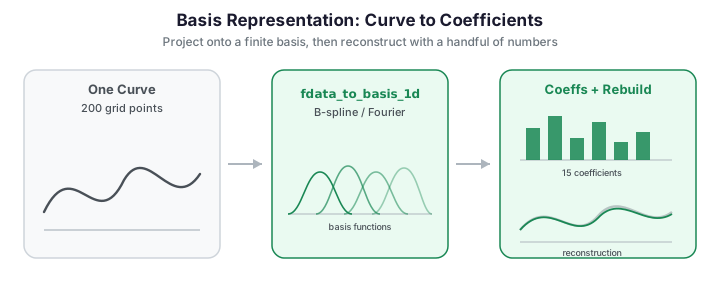
Representing functional data in a finite basis -- B-splines, Fourier, or P-splines -- converts a discrete set of evaluations into a compact coefficient vector. This enables smoothing, differentiation, integration, and dimensionality reduction, all while preserving the continuous nature of the underlying functions.
When to use basis representations
- Smoothing noisy data -- P-spline penalties remove high-frequency noise while preserving shape.
- Dimension reduction -- a curve with 500 grid points can be faithfully captured by 15-20 basis coefficients.
- Derivative computation -- analytic derivatives come for free from the basis expansion.
- Regularization -- roughness penalties in the basis domain prevent overfitting in regression.
A basis representation writes each curve as a finite linear combination of \(K\) fixed basis functions \(\phi_j\),
so the entire curve is compressed into the coefficient vector \(\mathbf c = (c_1, \ldots, c_K)\). For discretized data observed at grid points with design matrix \(B_{ij} = \phi_j(t_i)\), the unpenalized coefficients are the ordinary least-squares solution
The core trade-off is resolution versus compression: too few basis functions oversmooth and miss features, too many reproduce noise. The figure below projects one curve onto B-spline bases of increasing size and reconstructs it -- the fit sharpens as the basis grows.
import numpy as np
from docs_fig import fig, render
from fdars.simulation import simulate
from fdars.basis import fdata_to_basis_1d, basis_to_fdata_1d

t = np.linspace(0, 1, 200)
X = np.asarray(simulate(n=1, argvals=t, n_basis=8, efun_type="fourier", seed=3))

f, ax = fig()
for nb in (4, 8, 20):
    c, actual = fdata_to_basis_1d(X, t, n_basis=nb, basis_type="bspline")
    rec = np.asarray(basis_to_fdata_1d(c, t, n_basis=actual, basis_type="bspline"))
    ax.plot(t, rec[0], lw=1.8, label=f"n_basis = {actual}")
ax.plot(t, X[0], color="k", lw=2.4, ls=":", alpha=0.9, zorder=5,
        label="target curve")
ax.set(title="B-spline reconstruction at increasing basis size",
       xlabel="t", ylabel="X(t)")
ax.legend()
print(render(f))
With only 4 basis functions the reconstruction is a smooth caricature that misses the finer wiggles of the target (black dotted); by 20 it is visually indistinguishable from the target. This illustrates the resolution-versus-compression trade-off: more coefficients buy fidelity at the cost of a larger representation.
B-spline vs Fourier basis
| Property | B-spline | Fourier |
|---|---|---|
| Support | Local (compact) | Global |
| Best for | Non-periodic data, local features | Periodic / seasonal data |
| Boundary behavior | Handles edges naturally | Assumes periodicity |
| Derivative stability | Excellent | Excellent |
| Basis count rule of thumb | ~1 per interior knot + order | Must be odd (\(2k + 1\)) |
When the basis matters: a non-periodic signal
The choice really bites when the signal is non-periodic with local features. Consider a curve built from a polynomial trend, a narrow Gaussian bump, and a one-sided sharp edge -- exactly the kind of structure a global sinusoidal basis struggles with. Selecting the number of basis functions by GCV for each family and reconstructing the smooth signal (here the sample mean of a noisy ensemble) shows the B-spline winning by a wide margin, while the Fourier fit rings around the bump and the edge (a Gibbs phenomenon).
import numpy as np
from docs_fig import fig, render
from fdars.basis import basis_nbasis_cv, fdata_to_basis_1d, basis_to_fdata_1d

rng = np.random.default_rng(123)
t = np.linspace(0, 1, 120)

def complex_signal(t):
    trend = 2 * t ** 2 - t
    bump = 0.8 * np.exp(-((t - 0.3) ** 2) / (2 * 0.05 ** 2))   # localized feature
    sharp = 0.5 * np.sqrt(np.maximum(0.0, t - 0.7))            # sharp edge
    return trend + bump + sharp

true = complex_signal(t)
X = np.array([true + 0.15 * rng.standard_normal(t.size)
              for _ in range(30)])

# GCV-select the basis count for each family (over the noisy ensemble).
cb = basis_nbasis_cv(X, t, nbasis_min=5, nbasis_max=25, basis_type="bspline")
cf = basis_nbasis_cv(X, t, nbasis_min=5, nbasis_max=25, basis_type="fourier")
nb, nf = int(cb["optimal_nbasis"]), int(cf["optimal_nbasis"])

# Reconstruct the smooth sample mean at each family's optimum. Projecting the
# smooth target (rather than a single noisy realization) isolates the basis's
# approximation error from the observation noise.
mean = X.mean(axis=0, keepdims=True)
cbc, ab = fdata_to_basis_1d(mean, t, n_basis=nb, basis_type="bspline")
recb = np.asarray(basis_to_fdata_1d(cbc, t, n_basis=ab, basis_type="bspline"))
cfc, af = fdata_to_basis_1d(mean, t, n_basis=nf, basis_type="fourier")
recf = np.asarray(basis_to_fdata_1d(cfc, t, n_basis=af, basis_type="fourier"))

f, (a0, a1) = fig(1, 2, figsize=(11, 3.9))
a0.plot(np.asarray(cb["nbasis_range"]), np.asarray(cb["scores"]), "o-",
        color="#3f51b5", label=f"B-spline (min GCV {min(cb['scores']):.3f})")
a0.plot(np.asarray(cf["nbasis_range"]), np.asarray(cf["scores"]), "s-",
        color="#e8710a", label=f"Fourier (min GCV {min(cf['scores']):.3f})")
a0.set(title="GCV vs basis count (lower is better)",
       xlabel="number of basis functions", ylabel="GCV score")
a0.legend()

a1.plot(t, true, color="#6c757d", lw=2, ls="--", label="true signal")
a1.plot(t, recb[0], color="#3f51b5", lw=1.8, label=f"B-spline (K={ab})")
a1.plot(t, recf[0], color="#e8710a", lw=1.8, label=f"Fourier (K={af})")
a1.set(title="B-spline captures the bump; Fourier rings",
       xlabel="t", ylabel="X(t)")
a1.legend()
print(render(f))
For this signal the B-spline optimum reaches a markedly lower GCV than the Fourier optimum, and its reconstruction tracks the bump and the edge closely while the Fourier fit oscillates around them -- confirming the rule of thumb that local, non-periodic features call for a locally supported basis. (The Fourier oscillation around the bump and edge is the expected Gibbs phenomenon for a global sinusoidal basis on non-periodic data, not a numerical defect.)
Basis-count selection vs. penalised smoothing
basis_nbasis_cv selects the basis dimension with no roughness penalty by
default (lambda_=0): the number of basis functions is the smoothing control, so its
GCV/AIC/BIC curve has a genuine interior minimum. (Applying a positive lambda_ here
would saturate the effective degrees of freedom and flatten the curve toward the
largest n_basis.) When you instead want to fix the basis count and tune smoothness
continuously, use P-splines (pspline_fit_gcv, below), whose roughness penalty
selects smoothness directly.
Quick start: project and reconstruct
import numpy as np
from fdars import Fdata
from fdars.basis import fdata_to_basis_1d, basis_to_fdata_1d

# Simulate some data
argvals = np.linspace(0, 1, 200)
data = np.column_stack([np.sin(2 * np.pi * argvals) + 0.2 * np.random.randn(200)
                        for _ in range(30)]).T  # shape (30, 200)
fd = Fdata(data, argvals=argvals)

# Project onto a B-spline basis with 15 functions
coeffs, actual_nbasis = fdata_to_basis_1d(fd.data, fd.argvals, n_basis=15,
                                           basis_type="bspline")
print(f"Coefficients shape: {coeffs.shape}")   # (30, 15)
print(f"Actual n_basis used: {actual_nbasis}")

# Reconstruct back to the evaluation grid
reconstructed = basis_to_fdata_1d(coeffs, fd.argvals, n_basis=actual_nbasis,
                                   basis_type="bspline")
print(f"Reconstructed shape: {reconstructed.shape}")  # (30, 200)
Fourier basis for periodic data
# Periodic data: use Fourier basis
argvals_p = np.linspace(0, 2 * np.pi, 200)
periodic_data = np.column_stack([
    np.sin(argvals_p) + 0.5 * np.cos(3 * argvals_p) + 0.15 * np.random.randn(200)
    for _ in range(30)
]).T
fd_p = Fdata(periodic_data, argvals=argvals_p)

coeffs_f, nbasis_f = fdata_to_basis_1d(fd_p.data, fd_p.argvals, n_basis=11,
                                         basis_type="fourier")
reconstructed_f = basis_to_fdata_1d(coeffs_f, fd_p.argvals, n_basis=nbasis_f,
                                     basis_type="fourier")
Constant basis
The constant basis is the simplest possible basis: a single function \(\phi_1(t) = 1\) that is one everywhere on the domain. Its basis matrix is an \(m \times 1\) all-ones vector, so projection onto it computes the curve mean and reconstruction gives the constant mean surface.
Use cases include:
- Intercept column in a functional regression design matrix (the "level" component in a model \(X(t) = c_0 \cdot 1 + \sum_{j>0} c_j \phi_j(t)\)).
- Mean-correction reference -- subtract the constant-basis projection before applying depth or alignment methods to remove the global offset.
- Sanity check -- if a functional method is tested against the constant basis, its output should collapse to a scalar (the projected coefficient equals the observed mean).
The function takes a single argument -- the evaluation grid -- and returns a 1-D array of ones with the same length.
import numpy as np
from fdars.basis import constant_basis

t = np.linspace(0, 1, 50)
phi = np.asarray(constant_basis(t))

print(f"Shape:   {phi.shape}")       # (50,)
print(f"All ones: {np.all(phi == 1.0)}  FDARS_FENCE_OK")
| Parameter | Description |
|---|---|
argvals |
Evaluation grid, length m |
| Return | Description |
|---|---|
ndarray (m,) |
All-ones float64 array |
One function, one coefficient
Because the constant basis has exactly one function, fdata_to_basis_1d with n_basis=1 and any basis type does NOT produce the constant basis — it produces the first B-spline or Fourier function. Use constant_basis directly when you need the intercept vector.
Evaluating basis matrices directly
For advanced use (e.g., building your own penalty matrices), you can evaluate the raw basis matrix.
B-spline basis
from fdars.basis import bspline_basis

argvals = np.linspace(0, 1, 100)
B = bspline_basis(argvals, nknots=10, order=4)
print(B.shape)  # (100, 14) -- nknots + order = 14 basis functions
| Parameter | Description |
|---|---|
argvals |
Evaluation points |
nknots |
Number of equally spaced interior knots |
order |
Spline order: 4 = cubic (default), 3 = quadratic |
Fourier basis
from fdars.basis import fourier_basis

argvals = np.linspace(0, 2 * np.pi, 100)
F = fourier_basis(argvals, n_basis=11)
print(F.shape)  # (100, 11)
The Fourier basis consists of \(1, \sin(\omega t), \cos(\omega t), \sin(2\omega t), \cos(2\omega t), \ldots\) where \(\omega = 2\pi / T\) and \(T\) is the period (range of argvals).
The two basis families look very different: B-splines are local bumps with compact support, while Fourier functions are global sinusoids. This is why B-splines excel at local features and Fourier at periodic signals.
Each B-spline (left) is a localized bump that is non-zero only over a short sub-interval, so changing one coefficient perturbs the fit locally. The Fourier functions (right) are global sinusoids of increasing frequency spanning the whole domain, so each coefficient affects the fit everywhere -- which is why B-splines suit local features and Fourier suits periodic signals.
Fourier n_basis
n_basis should be odd. If an even value is given, it will be adjusted to the next odd number so the basis contains matched sine-cosine pairs plus the constant function.
P-spline smoothing
P-splines combine a rich B-spline basis with a discrete roughness penalty on the coefficients. The penalty parameter \(\lambda\) controls the trade-off between fit and smoothness.
where \(B\) is the B-spline basis matrix, \(D^d\) is the \(d\)-th order difference matrix, and \(\lambda \ge 0\).
Fixed lambda
from fdars.basis import pspline_fit_1d

result = pspline_fit_1d(fd.data, fd.argvals, n_basis=25, lambda_=1e-2, order=2)

print(result.keys())
# dict_keys(['fitted', 'coefficients', 'edf', 'rss', 'gcv', 'aic', 'bic'])
| Key | Description |
|---|---|
fitted |
Smoothed curves, shape (n, m) |
coefficients |
B-spline coefficients, shape (n, n_basis) |
edf |
Effective degrees of freedom |
rss |
Residual sum of squares |
gcv |
Generalized cross-validation score |
aic |
Akaike information criterion |
bic |
Bayesian information criterion |
Automatic lambda via GCV
When you do not know the right smoothing level, let GCV choose:
from fdars.basis import pspline_fit_gcv

result = pspline_fit_gcv(fd.data, fd.argvals, n_basis=25, order=2)
print(f"GCV score: {result['gcv']:.6f}")
print(f"Effective degrees of freedom: {result['edf']:.1f}")
Choosing n_basis for P-splines
With P-splines the exact number of basis functions matters less because the penalty controls smoothness. A safe rule is to use a generous basis (e.g., 20-40 functions for 100-500 grid points) and rely on \(\lambda\) to prevent overfitting.
Comparing smoothing levels
The penalty \(\lambda\) interpolates between an unpenalized (wiggly) B-spline fit and a nearly-linear fit. Sweeping it over several orders of magnitude on a noisy sinusoid shows the effect directly, with the effective degrees of freedom shrinking as \(\lambda\) grows.
import numpy as np
from docs_fig import fig, render
from fdars.basis import pspline_fit_1d

rng = np.random.default_rng(11)
t = np.linspace(0, 1, 120)
true = np.sin(2 * np.pi * t) + 0.5 * np.sin(4 * np.pi * t)
X = np.array([true + 0.3 * rng.standard_normal(t.size) for _ in range(30)])

f, axes = fig(1, 4, figsize=(14, 3.4), sharey=True)
for ax, lam in zip(axes, [1e-4, 1e-2, 1.0, 1e2]):
    res = pspline_fit_1d(X, t, n_basis=25, lambda_=lam, order=2)
    ax.plot(t, X[0], ".", ms=2, alpha=0.35, color="#6c757d", label="raw")
    ax.plot(t, np.asarray(res["fitted"])[0], color="#dc3545", lw=2,
            label=f"edf={res['edf']:.1f}")
    ax.set(title=f"$\\lambda$ = {lam:.0e}", xlabel="t")
    ax.legend(fontsize=8)
axes[0].set_ylabel("X(t)")
print(render(f))
As \(\lambda\) increases from left to right the fitted curve (red) goes from interpolating the noise to an almost straight line, and the effective degrees of freedom in each legend fall accordingly. The middle panels (\(\lambda \approx 10^{-2}\)) strike the balance -- tracking the true sinusoid without chasing the scatter.
Automatic basis selection
select_basis_auto_1d jointly selects:
- Basis type -- B-spline or Fourier (optionally using an FFT-based seasonality hint).
- Number of basis functions -- optimizing GCV, AIC, or BIC.
- P-spline penalty -- when using B-splines.
from fdars.basis import select_basis_auto_1d

selections = select_basis_auto_1d(fd.data, fd.argvals, criterion="gcv")

# Each element corresponds to one curve
for i, sel in enumerate(selections[:3]):
    print(f"Curve {i}: basis={sel['basis_type']}, nbasis={sel['nbasis']}, "
          f"score={sel['score']:.4f}, seasonal={sel['seasonal_detected']}")
| Parameter | Default | Description |
|---|---|---|
criterion |
"gcv" |
"gcv", "aic", or "bic" |
nbasis_min |
0 (auto) | Lower bound for basis count search |
nbasis_max |
0 (auto) | Upper bound for basis count search |
lambda_pspline |
-1.0 (auto) | P-spline penalty; negative triggers GCV selection |
use_seasonal_hint |
True |
Use FFT to detect periodicity and prefer Fourier |
Each element of the returned list is a dict with:
| Key | Description |
|---|---|
basis_type |
"bspline" or "fourier" |
nbasis |
Optimal number of basis functions |
score |
Information criterion score |
coefficients |
Basis coefficients for this curve |
fitted |
Fitted values for this curve |
edf |
Effective degrees of freedom |
seasonal_detected |
Whether the FFT hint detected periodicity |
lambda_val |
Selected P-spline penalty (if B-spline) |
Cross-validated basis count
When you want to fix the basis type and only search over the number of basis functions:
from fdars.basis import basis_nbasis_cv

cv_result = basis_nbasis_cv(
    fd.data, fd.argvals,
    nbasis_min=4,
    nbasis_max=30,
    basis_type="bspline",
    criterion="gcv",
    n_folds=5,
    lambda_=1.0,
)

print(f"Optimal n_basis: {cv_result['optimal_nbasis']}")
print(f"Criterion used:  {cv_result['criterion']}")
Plotting the CV curve
nbasis_range = cv_result["nbasis_range"]
scores = cv_result["scores"]

plt.figure(figsize=(7, 4))
plt.plot(nbasis_range, scores, "o-", color="steelblue")
plt.axvline(cv_result["optimal_nbasis"], ls="--", color="coral",
            label=f"Optimal = {cv_result['optimal_nbasis']}")
plt.xlabel("Number of basis functions")
plt.ylabel(f"{cv_result['criterion'].upper()} score")
plt.title("Basis count selection")
plt.legend()
plt.tight_layout()
plt.show()
Information criteria reference
| Criterion | Formula | Tends to select |
|---|---|---|
| GCV | \(\displaystyle\frac{n^{-1}\,\text{RSS}}{(1 - \text{edf}/n)^2}\) | Moderate smoothness |
| AIC | \(n\log(\text{RSS}/n) + 2\,\text{edf}\) | Slightly more complex models |
| BIC | \(n\log(\text{RSS}/n) + \log(n)\,\text{edf}\) | Simpler (sparser) models |
GCV vs CV
GCV is a leave-one-out cross-validation approximation that avoids refitting. For small samples, explicit \(k\)-fold CV (set criterion="cv" in basis_nbasis_cv) may be more reliable.
Comparing the smoothing approaches
The three routes -- a fixed basis, a CV-selected basis count, and a P-spline with GCV-selected penalty -- can be run side by side. On noisy sinusoidal data, the CV-optimal basis and the P-spline both recover the underlying signal closely, while a too-small fixed basis oversmooths. The two plain-basis routes reconstruct the smooth sample mean (isolating approximation error from noise), while the P-spline denoises a single raw curve directly.
import numpy as np
from docs_fig import fig, render
from fdars.basis import (fdata_to_basis_1d, basis_to_fdata_1d,
                         basis_nbasis_cv, pspline_fit_gcv)

rng = np.random.default_rng(7)
t = np.linspace(0, 1, 150)
true = np.sin(2 * np.pi * t) + 0.5 * np.sin(4 * np.pi * t)
X = np.array([true + 0.3 * rng.standard_normal(t.size) for _ in range(30)])
mean = X.mean(axis=0, keepdims=True)   # smooth target for the plain-basis routes

# 1. Fixed small B-spline basis -- reconstructing the smooth mean.
c5, n5 = fdata_to_basis_1d(mean, t, n_basis=5, basis_type="bspline")
fix = np.asarray(basis_to_fdata_1d(c5, t, n_basis=n5, basis_type="bspline"))

# 2. CV-selected B-spline basis count.
cv = basis_nbasis_cv(X, t, nbasis_min=5, nbasis_max=21, basis_type="bspline")
kcv = int(cv["optimal_nbasis"])
ccv, ncv = fdata_to_basis_1d(mean, t, n_basis=kcv, basis_type="bspline")
cvfit = np.asarray(basis_to_fdata_1d(ccv, t, n_basis=ncv, basis_type="bspline"))

# 3. P-spline with GCV-selected lambda -- denoising a single raw curve.
ps = pspline_fit_gcv(X[:1], t, n_basis=25, order=2)
psfit = np.asarray(ps["fitted"])

f, ax = fig()
ax.plot(t, X[0], ".", ms=2, alpha=0.3, color="#6c757d", label="observed")
ax.plot(t, true, color="k", lw=1.6, ls="--", label="true signal")
ax.plot(t, fix[0], color="#0dcaf0", lw=1.8, label=f"fixed B-spline (K={n5})")
ax.plot(t, cvfit[0], color="#198754", lw=1.6, label=f"CV B-spline (K={ncv})")
ax.plot(t, psfit[0], color="#6f42c1", lw=1.6, label="P-spline (GCV λ)")
ax.set(title="Fixed vs CV-selected basis vs P-spline", xlabel="t", ylabel="X(t)")
ax.legend(fontsize=8)
print(render(f))
The CV-selected B-spline (green) and the GCV P-spline (purple) both hug the dashed true signal, whereas the small fixed basis (cyan) visibly oversmooths and misses the second harmonic. This is the practical payoff of letting a criterion choose the complexity rather than fixing it too low.
Recommendations
| Situation | Recommended approach |
|---|---|
| Periodic data | Fourier basis with GCV-selected n_basis |
| Non-periodic data with local features | B-spline basis with GCV-selected n_basis |
| Heavy noise | P-splines with automatic \(\lambda\) (pspline_fit_gcv) |
| Fast processing | Fixed basis type and count (fdata_to_basis_1d) |
| Don't know the family | select_basis_auto_1d (chooses type + count) |
| Robust selection | basis_nbasis_cv with criterion="cv" and n_folds |
API summary
| Function | Description |
|---|---|
fdata_to_basis_1d(data, argvals, n_basis, basis_type) |
Project curves onto a basis |
basis_to_fdata_1d(coeffs, argvals, n_basis, basis_type) |
Reconstruct curves from coefficients |
bspline_basis(argvals, nknots, order) |
Evaluate raw B-spline basis matrix |
fourier_basis(argvals, n_basis) |
Evaluate raw Fourier basis matrix |
pspline_fit_1d(data, argvals, n_basis, lambda_, order) |
P-spline fit with fixed \(\lambda\) |
pspline_fit_gcv(data, argvals, n_basis, order) |
P-spline fit with GCV-selected \(\lambda\) |
select_basis_auto_1d(data, argvals, ...) |
Automatic basis type + count selection |
basis_nbasis_cv(data, argvals, ...) |
Cross-validated basis count selection |
smooth_basis_gcv(data, argvals, n_basis, ...) |
Basis smoothing with GCV penalty selection |
constant_basis(argvals) |
Constant (intercept) basis — all-ones vector |
All functions are imported from fdars.basis.
References
- Ramsay, J.O., Silverman, B.W. (2005). Functional Data Analysis, 2nd ed. Springer.
- Eilers, P.H.C., Marx, B.D. (1996). Flexible smoothing with B-splines and penalties. Statistical Science 11(2), 89-121.
- de Boor, C. (1978). A Practical Guide to Splines. Springer.
- Craven, P., Wahba, G. (1979). Smoothing noisy data with spline functions: estimating the correct degree of smoothing by the method of generalized cross-validation. Numerische Mathematik 31(4), 377-403.