Align
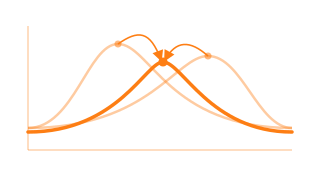
Register and align curves to separate amplitude from phase variability.
Functional observations often exhibit two fundamentally different sources of variation: amplitude (how tall or deep the features are) and phase (when those features occur). Standard statistical methods conflate the two, leading to washed-out means and inflated variance estimates. The Align module provides elastic alignment tools built on the Fisher-Rao metric and the Square Root Slope Function (SRSF) framework to cleanly decompose these sources of variability.
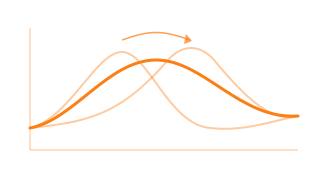
Elastic Alignment
SRSF registration, Karcher mean, and amplitude/phase separation.
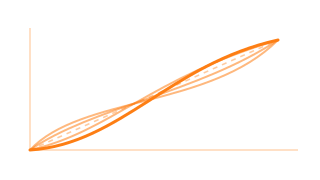
Advanced Elastic Alignment
Closed, constrained, penalized, and multi-resolution alignment.
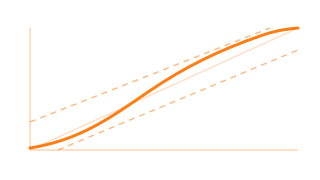
Banded Elastic Alignment
Fast Karcher mean via a diagonal DP band constraint.
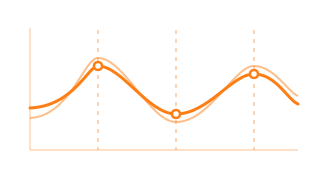
Landmark Registration
Align curves by matching landmark locations with monotone warps.
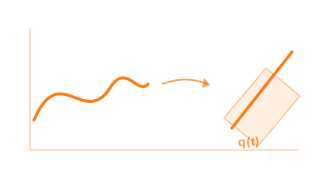
TSRVF
Linearized elastic analysis in a transported tangent space.
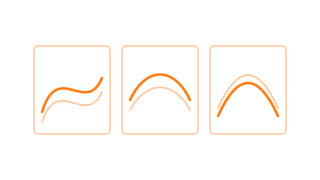
Comparing Methods
No alignment vs elastic vs landmark, side by side.
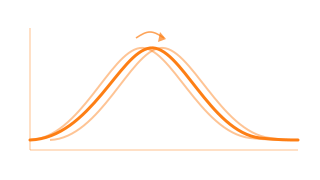
Shift Registration
Align curves by a single scalar time-shift per observation.
Shape Analysis
Shape-preserving registration and geodesic computations.
Scope & limitations
fdars alignment operates on real-valued curves sampled on a single shared grid (argvals) common to every observation — the Fdata constructor and stack enforce this. Keep these boundaries in mind:
- Sparse or irregular per-curve sampling is not supported. Pre-smooth each curve onto the shared grid first. The one exception is
elastic_partial_match, which accepts two mismatched grids but is strictly pairwise. - The elastic machinery is 1-D (SRSF / Fisher–Rao). For ordinary real-valued curves in Euclidean space, TSRVF collapses to SRVF. Genuinely manifold-valued trajectories (sphere, SPD/covariance-over-time, shapes, rotations) are not supported — there are no exp/log maps, geodesic mean, or PGA.
- Constrained-range or density-valued curves are not supported. Transform them to an unconstrained space before aligning.
- Supported beyond the basics: closed/periodic curves (
elastic_align_pair_closed,karcher_mean_closed) and landmark-constrained alignment (elastic_align_pair_constrained).