Elastic Alignment
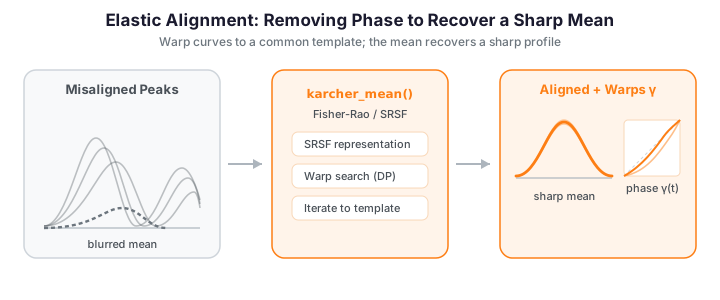
The problem: amplitude vs. phase variability
Imagine recording the heartbeat signal of several patients. Every heartbeat has the same features -- a P wave, a QRS complex, a T wave -- but the timing of those features differs from patient to patient. Average the raw signals and the peaks blur out, because they do not line up. Two distinct sources of variation are at work whenever curves share a domain:
- Amplitude variability -- differences in the height of features (peaks, valleys).
- Phase variability -- differences in the timing of features (shifted or stretched along the domain axis).
Classical statistics -- the cross-sectional mean, ordinary FPCA -- treats all variation as amplitude. The result is a blurred mean and artificially inflated variance. Elastic alignment resolves this by finding time-warping functions \(\gamma\) that register each curve to a common template, isolating amplitude variation in the aligned curves and phase variation in the warps:
The panels below show the same set of two-peak curves before alignment -- where the peaks land at different times, blurring the cross-sectional mean -- and after Karcher-mean alignment, where the peaks snap into register and the mean recovers a sharp two-peak profile.
On the left the peaks arrive at different times, so the red cross-sectional mean is blunted and shifted -- it does not look like any single curve. On the right the Fisher-Rao alignment warps every curve onto the common Karcher mean, and the orange mean now reproduces the true peaked shape. This side-by-side is the canonical illustration of amplitude/phase separation.
Fisher-Rao framework
All alignment in fdars is performed under the elastic (Fisher-Rao) metric, the unique Riemannian metric on the function space that is invariant to simultaneous reparameterization. This guarantees the alignment is proper: the distance between two functions does not depend on how either is parameterized.
Numerical validation
Two ground-truth properties of the elastic machinery, asserted below:
- Alignment removes variance. After Karcher-mean alignment of a phase-varying sample, the mean pointwise variance must drop, so the variance reduction \(\text{VR}=1-\overline{\operatorname{Var}}(\tilde f)/\overline{\operatorname{Var}}(f)\) is strictly positive.
- Amplitude = elastic distance. For the residual after optimal alignment,
amplitude_distanceis by definition the elastic distance; the two must agree to machine precision.
variance reduction after alignment: 0.931 (> 0 required) amplitude vs elastic distance: 0.443239 vs 0.443239 (|diff| = 0.00e+00)
Both assertions pass: the variance reduction is strictly positive (alignment genuinely removed phase spread), and amplitude_distance reproduces elastic_distance to machine precision -- confirming they are the same quantity by construction, not merely close.
How it works (intuition)
Elastic alignment stretches and compresses the time axis of each curve until corresponding features line up. The key trick is to work in the Square-Root Slope Function (SRSF) representation -- a transformed version of the curve that turns the awkward Fisher-Rao geometry into ordinary \(L^2\) geometry. In SRSF space, finding the best alignment reduces to a standard dynamic-programming problem that solves in \(O(m^2)\) time.
After alignment, variability splits cleanly into two parts:
- Amplitude variability -- genuine differences in curve shape (how tall the peaks are, how deep the valleys).
- Phase variability -- differences in timing (when the peaks occur), captured entirely by the warping functions.
The Karcher mean is the average shape, computed after alignment. Unlike the ordinary mean, it preserves sharp features because the peaks are registered before averaging.
Mathematical framework
The space of warping functions
Let \(\mathcal{F}\) be the space of absolutely continuous functions \(f:[0,1]\to\mathbb{R}\). The warping group is
\(\Gamma\) acts on \(\mathcal{F}\) by composition: \((f\circ\gamma)(t)=f(\gamma(t))\). This reparameterizes a curve without changing its shape -- only the speed at which the curve is traversed changes.
The Fisher-Rao metric
The Fisher-Rao metric is the unique Riemannian metric (up to scaling) invariant under the action of \(\Gamma\). It is hard to compute directly because it involves \(f\)'s derivative in a denominator. The SRSF transform resolves this by isometrically mapping Fisher-Rao geometry onto a flat \(L^2\) space.
SRSF transform
The Square-Root Slope Function of \(f\) is
It has three key properties:
- Isometry -- the Fisher-Rao distance between \(f_1,f_2\) equals the \(L^2\) distance between their SRSFs after optimal alignment.
- Equivariance -- under \(f\mapsto f\circ\gamma\) the SRSF transforms as \(q\mapsto(q\circ\gamma)\sqrt{\dot\gamma}\), the standard action of \(\Gamma\) on \(L^2\).
- Invertibility -- given \(q\) and an initial value \(f(0)\), the function is recovered by \(f(t)=f(0)+\int_0^t q(s)\lvert q(s)\rvert\,ds\).
The SRSF is available directly; the transform loses only the initial offset \(f(0)\), which you pass back to srsf_inverse to reconstruct the curve exactly.
import numpy as np
from docs_fig import fig, render
from fdars.alignment import srsf_transform, srsf_inverse

t = np.linspace(0, 1, 100)
f = np.sin(2 * np.pi * t) + 0.4 * np.sin(4 * np.pi * t)

q = srsf_transform(f, t)                    # forward
f_rec = srsf_inverse(q, t, initial_value=f[0])  # inverse (needs f(0))
print(f"Round-trip max error: {np.max(np.abs(f - f_rec)):.2e}")

f2, (a1, a2) = fig(ncols=2, figsize=(9.5, 3.6))
a1.plot(t, f, color="#3f51b5", lw=1.8)
a1.set(title="Original curve $f$", xlabel="t", ylabel="f(t)")
a2.plot(t, np.asarray(q), color="#6f42c1", lw=1.8)
a2.set(title="SRSF representation $q$", xlabel="t", ylabel="q(t)")
print(render(f2))
The right panel is the curve's SRSF: it emphasizes the slopes of \(f\), crossing zero exactly where \(f\) has an extremum. The tiny printed round-trip error confirms the transform is losslessly invertible once \(f(0)\) is supplied, which is what lets us do all the geometry in SRSF space and map back.
Note
The SRSF drops \(f(0)\). Pass initial_value to srsf_inverse to recover the original function exactly (the round-trip error above is at the level of numerical integration).
Alignment as optimization
Given \(f_1,f_2\) with SRSFs \(q_1,q_2\), optimal alignment finds
solved by dynamic programming in \(O(m^2)\). The aligned function is \(f_2\circ\gamma^\*\), and the elastic distance is the residual \(L^2\) norm. It satisfies all metric axioms and is invariant to reparameterization: \(d_e(f_1,f_2)=d_e(f_1\circ\gamma, f_2\circ\gamma)\) for any \(\gamma\in\Gamma\).
Amplitude-phase decomposition and variance reduction
For a sample \(f_1,\dots,f_n\) with aligned versions \(\tilde f_i=f_i\circ\gamma_i^\*\):
- Amplitude variability is the residual variance in \(\tilde f_1,\dots,\tilde f_n\) -- genuine shape differences.
- Phase variability is the variability in the warps \(\gamma_1^\*,\dots,\gamma_n^\*\) themselves -- timing differences.
The variance reduction (VR) quantifies how much of the total variance was phase,
where \(\overline{\operatorname{Var}}\) is the mean pointwise variance. VR near 1 means the variation was almost all phase (and has been removed); VR near 0 means it was almost all amplitude.
Karcher mean
The Karcher mean (Frechet mean under the elastic metric) minimizes the sum of squared elastic distances,
Because \(d_e\) accounts for reparameterization, \(\mu^\*\) is a shape-preserving average. The algorithm iterates: (1) initialize \(\hat\mu\) at the cross-sectional mean, (2) align every curve to \(\hat\mu\), (3) update \(\hat\mu\) to the mean of the aligned curves, and (4) repeat until \(\hat\mu\) stops moving -- typically 5-20 iterations.
Pairwise alignment
Align a single curve to a reference. The optimizer returns the aligned curve, the warp \(\gamma^\*\), and the elastic distance.
from fdars.alignment import elastic_align_pair

t = np.linspace(0, 1, 101)
f1 = np.sin(2 * np.pi * t)
f2 = np.sin(2 * np.pi * (t - 0.1))  # phase-shifted

result = elastic_align_pair(f1, f2, t, lambda_=0.0)

f2_aligned = result["f_aligned"]   # f2 warped to match f1, shape (101,)
gamma      = result["gamma"]       # warping function, shape (101,)
distance   = result["distance"]    # elastic distance (scalar)

print(f"Elastic distance: {distance:.4f}")
print(f"Max alignment residual: {np.max(np.abs(f1 - f2_aligned)):.6f}")
| Key | Type | Description |
|---|---|---|
f_aligned |
ndarray (m,) |
Second curve warped to match the first |
gamma |
ndarray (m,) |
Optimal warping function \(\gamma^\*\) |
distance |
float |
Elastic distance after alignment |
Regularization
Increase lambda_ to penalize complex warping functions and obtain smoother alignments. 0.0 allows unconstrained warping; values around 0.01--1.0 give moderate regularization. See Advanced Alignment for penalty variants and cross-validated selection.
Group alignment: Karcher mean
The Karcher mean simultaneously aligns all curves and computes their elastic average, iterating between aligning every curve to the current mean and recomputing the mean from the aligned curves.
from fdars import Fdata
from fdars.alignment import karcher_mean

# 30 curves with random phase shifts
np.random.seed(0)
n, m = 30, 101
t = np.linspace(0, 1, m)
shifts = np.random.uniform(-0.15, 0.15, n)
fd = Fdata(np.array([np.sin(2 * np.pi * (t - s)) for s in shifts]), argvals=t)

result = karcher_mean(fd.data, t, lambda_=0.0, max_iter=20, tol=1e-4)

mu        = result["mean"]          # Karcher mean, shape (m,)
mu_srsf   = result["mean_srsf"]     # mean in SRSF space, shape (m,)
aligned   = result["aligned_data"]  # aligned curves, shape (n, m)
gammas    = result["gammas"]        # warping functions, shape (n, m)
n_iter    = result["n_iter"]        # iterations used
converged = result["converged"]     # bool

print(f"Converged in {n_iter} iterations: {converged}")
| Key | Type | Description |
|---|---|---|
mean |
ndarray (m,) |
Karcher mean function |
mean_srsf |
ndarray (m,) |
Mean in SRSF representation |
aligned_data |
ndarray (n, m) |
All curves aligned to the mean |
gammas |
ndarray (n, m) |
Warping functions for each curve |
n_iter |
int |
Number of iterations performed |
converged |
bool |
Whether the algorithm converged |
The figure below contrasts the two averages directly: the cross-sectional mean is attenuated by the phase shifts, while the Karcher mean recovers the true amplitude.
import numpy as np
from docs_fig import fig, render
from fdars.alignment import karcher_mean

rng = np.random.default_rng(42)
n, m = 20, 100
t = np.linspace(0, 1, m)
# shifted bumps
data = np.array([np.exp(-25 * (t - 0.5 - rng.uniform(-0.1, 0.1)) ** 2)
                 for _ in range(n)])

km = karcher_mean(data, t, max_iter=30, tol=1e-4)
mu = np.asarray(km["mean"])

f, ax = fig()
ax.plot(t, data.T, color="#6c757d", lw=0.8, alpha=0.3)
ax.plot(t, data.mean(0), color="#3f51b5", lw=2.4, label="cross-sectional mean")
ax.plot(t, mu, color="#dc3545", lw=2.4, label="Karcher mean")
ax.set(title="Cross-sectional vs. Karcher mean (shifted bumps)",
       xlabel="t", ylabel="f(t)")
ax.legend(fontsize=9)
print(render(f))
The blue cross-sectional mean is shorter and wider than any real bump -- averaging shifted peaks pointwise smears them out. The red Karcher mean instead keeps the true peak height and width, because it averages shapes after warping rather than heights at fixed times. This height loss is the single clearest symptom of ignoring phase.
Karcher median (robust central shape)
The Karcher median replaces the squared elastic distance with the unsquared distance, producing a more robust central tendency.
from fdars.alignment import karcher_median

result = karcher_median(fd.data, t, lambda_=0.0, max_iter=20, tol=1e-3)
mu_median = result["mean"]       # elastic median
weights   = result["weights"]    # observation weights, shape (n,)
The result has the same keys as karcher_mean, plus weights -- the iteratively reweighted importance of each observation.
Robust (trimmed) Karcher mean
When the sample contains outliers, the robust Karcher mean down-weights or excludes the most extreme observations.
from fdars.alignment import robust_karcher_mean

result = robust_karcher_mean(
    fd.data, t, lambda_=0.0, max_iter=20, tol=1e-3,
    trim_fraction=0.1,  # discard the 10% most distant curves
)
mu_robust = result["mean"]
weights   = result["weights"]  # zero for trimmed observations
Warning
Setting trim_fraction too high removes legitimate variation. Start at 0.05--0.10 and increase only if diagnostics confirm heavy contamination.
Interpreting warping functions
A warping function \(\gamma:[0,1]\to[0,1]\) is a monotonically increasing diffeomorphism. Its position relative to the diagonal and its slope encode local timing:
| Condition | Interpretation |
|---|---|
| \(\gamma(t) > t\) (above diagonal) | Feature occurs later in the original curve; alignment looks forward |
| \(\gamma(t) < t\) (below diagonal) | Feature occurs earlier; alignment looks backward |
| \(\dot\gamma(t) > 1\) | Region is stretched -- features spread over more reference time |
| \(\dot\gamma(t) < 1\) | Region is compressed -- features happen faster |
| \(\dot\gamma(t) = 1\) | No timing distortion at \(t\) |
Plotted together, the warps fan out around the identity diagonal: a \(\gamma\) bowing above the diagonal pulls features earlier, one bowing below pushes them later. Their spread is the phase variability that alignment separated out of the amplitude.
Differentiating \(\gamma\) gives its local warping speed \(\dot\gamma\), which makes the stretch/compress reading concrete.
# Inspect warping speed for the first curve
gamma_0 = gammas[0]
speed = np.gradient(gamma_0, t)

compressed = t[speed > 1.2]        # sped up
stretched  = t[speed < 0.8]        # slowed down
print(f"Compressed near t in {compressed[[0, -1]] if compressed.size else '(none)'}")
Elastic distance and its decomposition
Compute the elastic (Fisher-Rao) distance between two curves without returning the warp explicitly, then split it into orthogonal amplitude and phase components:
from fdars.alignment import elastic_distance, amplitude_distance, phase_distance

d_amp   = amplitude_distance(f1, f2, t)
d_phase = phase_distance(f1, f2, t)
d_total = elastic_distance(f1, f2, t)

print(f"Amplitude distance: {d_amp:.4f}")
print(f"Phase distance:     {d_phase:.4f}")
print(f"Total (elastic):    {d_total:.4f}")
For phase-shifted sine curves most of the distance comes from phase (timing), with little amplitude distance -- the shapes are similar once aligned.
The single-pair version, elastic_decomposition, returns the aligned curve and both distances in one call:
from fdars.alignment import elastic_decomposition

dec = elastic_decomposition(f1, f2, t, lambda_=0.0)
print(f"Amplitude: {dec['d_amplitude']:.4f}, Phase: {dec['d_phase']:.4f}")
f2_aligned = dec["f_aligned"]   # f2 aligned onto f1
Distance matrices
Compute pairwise elastic distances for an entire dataset. These matrices feed nonparametric regression, clustering, or classification, and can be visualized with multidimensional scaling.
import numpy as np
from docs_fig import fig, render
from fdars.alignment import elastic_self_distance_matrix

rng = np.random.default_rng(5)
n, m = 15, 100
t = np.linspace(0, 1, m)
data = np.array([np.sin(2 * np.pi * (t - rng.uniform(-0.1, 0.1))) for _ in range(n)])

D = np.asarray(elastic_self_distance_matrix(data, t, lambda_=0.0))
print("Symmetric:    ", bool(np.max(np.abs(D - D.T)) < 1e-8))
print("Zero diagonal:", bool(np.max(np.abs(np.diag(D))) < 1e-8))

# Classical MDS embedding of the elastic distances
n_ = D.shape[0]
J = np.eye(n_) - np.ones((n_, n_)) / n_
B = -0.5 * J @ (D ** 2) @ J
w, V = np.linalg.eigh(B)
emb = V[:, [-1, -2]] * np.sqrt(np.clip(w[[-1, -2]], 0, None))

f, ax = fig()
ax.scatter(emb[:, 0], emb[:, 1], color="#3f51b5", s=45)
ax.set(title="MDS of elastic distances", xlabel="MDS 1", ylabel="MDS 2")
print(render(f))
Cross-distances between two datasets (e.g. train vs. test) come from elastic_cross_distance_matrix:
from fdars.alignment import elastic_cross_distance_matrix

fd_train, fd_test = fd[:20], fd[20:]
D_cross = elastic_cross_distance_matrix(fd_train.data, fd_test.data, fd.argvals, lambda_=0.0)
print("Cross-distance shape:", np.asarray(D_cross).shape)  # (20, 10)
Alignment quality diagnostics
alignment_quality runs the elastic alignment internally and reports a suite of diagnostics -- how much variance is removed, and how the total splits into amplitude and phase.
import numpy as np
from docs_fig import fig, render
from fdars.alignment import karcher_mean, alignment_quality

rng = np.random.default_rng(42)
n, m = 20, 100
t = np.linspace(0, 1, m)
data = np.array([np.sin(2 * np.pi * (t - rng.uniform(-0.1, 0.1))) for _ in range(n)])

km = karcher_mean(data, t, max_iter=20, tol=1e-4)
aligned = np.asarray(km["aligned_data"])
q = alignment_quality(data, t, lambda_=0.0, max_iter=20)

# Pointwise variance before vs after -- where did alignment help?
var_before = np.var(data, axis=0)
var_after = np.var(aligned, axis=0)

f, ax = fig()
ax.fill_between(t, var_after, var_before, color="#3f51b5", alpha=0.18,
                label="variance removed")
ax.plot(t, var_before, color="#6c757d", ls="--", lw=1.6, label="before")
ax.plot(t, var_after, color="#3f51b5", lw=1.8, label="after")
ax.set(title="Pointwise variance: before vs. after alignment",
       xlabel="t", ylabel="variance")
ax.legend(fontsize=9)
print(render(f))

print()
print(f"mean variance reduction : {float(q['mean_variance_reduction']):.4f}")
print(f"phase / amplitude ratio : {float(q['phase_amplitude_ratio']):.4f}")
print(f"mean warp complexity    : {float(q['mean_warp_complexity']):.4f}")
The shaded gap between the dashed (before) and solid (after) curves is the variance alignment removed, and it is largest exactly where the curves were most out of phase. The printed variance-reduction and phase/amplitude numbers put a single figure on that gap -- a compact summary of how much of the spread was timing.
alignment_quality key |
Meaning |
|---|---|
mean_variance_reduction |
Fraction of pointwise variance removed by alignment (the VR metric) |
total_variance |
Total variance before decomposition |
amplitude_variance / phase_variance |
Variance attributable to amplitude / to phase |
phase_amplitude_ratio |
Phase share of total variance -- high means phase-dominated |
mean_warp_complexity |
Average geodesic distance of warps from the identity |
mean_warp_smoothness |
Average bending energy of the warps |
pointwise_variance_ratio |
Per-point post/pre variance ratio, shape (m,) |
A phase_amplitude_ratio near 1 confirms the variation is mostly timing -- precisely where alignment helps most.
Per-curve health checks
diagnose_alignment flags individual curves whose warps are over-complex, under-improving, or too rough, and returns a global health score.
from fdars.alignment import diagnose_alignment

diag = diagnose_alignment(data, t, max_iter=15)
print(f"Health score : {float(diag['health_score']):.3f}")
print(f"Flagged      : {int(diag['n_flagged'])} of {len(data)} curves")
print(f"Flagged idx  : {list(np.asarray(diag['flagged_indices']))}")
| Key | Description |
|---|---|
health_score |
Overall alignment health in \([0,1]\) (1 = all curves healthy) |
flagged_indices / n_flagged |
Curves failing a diagnostic threshold |
warp_complexity / warp_smoothness |
Per-curve warp metrics |
residuals |
Per-curve post-alignment residual |
pairwise_consistency complements this by checking whether alignment is internally coherent across triplets of curves; a low value can signal subgroups with genuinely different shapes.
from fdars.alignment import pairwise_consistency
pc = pairwise_consistency(data, t, max_triplets=100)
print(f"Pairwise consistency: {pc:.4f}")
When elastic alignment works -- and when it does not
Elastic alignment is not a cure-all. It shines when variability is genuinely timing, and it can do harm (or nothing) otherwise. The table below is a compact version of the fdars scenario gallery; each row was measured with the code that follows.
| Scenario | Typical VR | Verdict |
|---|---|---|
| Shifted peaks / bumps | 95--100% | Best case -- localized features with timing shifts |
| Multi-peak (ECG-like), spectral peaks | 95--100% | Excellent when peaks shift coherently |
| Phase-shifted smooth curves (sine, sigmoid) | 90--100% | Works well |
| Mixed amplitude + phase | 40--65% | Partial -- residual is real amplitude variation |
| Pure amplitude differences | ~0% | Identity warps -- no harm, no help |
| Genuinely different shapes | low / negative | Misuse -- forced warping; use depth/distance instead |
| Very noisy raw data | 0--30% | Smooth first -- SRSF amplifies derivative noise |
import numpy as np
from docs_fig import fig, render
from fdars.alignment import karcher_mean

def vr(data, t):
    aligned = np.asarray(karcher_mean(data, t, max_iter=20, tol=1e-4)["aligned_data"])
    return 1.0 - np.var(aligned, axis=0).mean() / np.var(data, axis=0).mean()

t = np.linspace(0, 1, 120)
scen = {}

# Shifted bumps -- best case
rng = np.random.default_rng(42)
scen["bumps"] = np.array([np.exp(-200 * (t - 0.5 - rng.uniform(-0.1, 0.1)) ** 2)
                          for _ in range(20)])
# Mixed amplitude + phase
rng = np.random.default_rng(42)
scen["mixed"] = np.array([rng.uniform(0.5, 1.5) * np.sin(2 * np.pi * (t - rng.uniform(-0.1, 0.1)))
                          for _ in range(20)])
# Pure amplitude
rng = np.random.default_rng(42)
scen["pure amp"] = np.array([rng.uniform(0.5, 2.0) * np.sin(2 * np.pi * t) for _ in range(20)])
# Different shapes
rng = np.random.default_rng(42)
shapes = [np.sin(2 * np.pi * t), np.cos(6 * np.pi * t), t ** 3,
          np.exp(-((t - 0.5) ** 2) / 0.002)]
scen["diff shapes"] = np.array([shapes[i % 4] for i in range(20)])

vrs = {k: 100 * vr(v, t) for k, v in scen.items()}

f, ax = fig()
names = list(vrs.keys())
ax.bar(names, [vrs[k] for k in names],
       color=["#198754", "#e8710a", "#6c757d", "#dc3545"])
ax.axhline(0, color="#333", lw=0.8)
ax.set(title="Variance reduction by scenario", ylabel="VR (%)")
for i, k in enumerate(names):
    ax.text(i, vrs[k], f"{vrs[k]:.0f}%", ha="center",
            va="bottom" if vrs[k] >= 0 else "top", fontsize=9)
print(render(f))
The read is intuitive: shifted bumps align almost perfectly; the mixed case leaves real amplitude variance behind (not a failure); pure-amplitude data yields identity warps (VR \(\approx 0\)); and forcing unrelated shapes into register produces little or even negative VR -- a signal to use depth or distance methods instead.
Smooth noisy data first
The SRSF transform differentiates the curve, so measurement noise gets amplified and drives spurious warping. Pre-smooth noisy curves (e.g. with a B-spline basis or a kernel smoother) before aligning. A minimum of 50--100 grid points is also recommended -- coarse grids limit the dynamic-programming resolution.
Multi-bump scaling: a fundamental limit
A single monotone warp cannot independently retime many closely spaced features: stretching one inter-peak interval forces compression of another. Alignment therefore degrades gracefully as the number of independently shifting bumps grows.
import numpy as np
from docs_fig import fig, render
from fdars.alignment import karcher_mean

def vr(data, t):
    aligned = np.asarray(karcher_mean(data, t, max_iter=20, tol=1e-4)["aligned_data"])
    return 100 * (1.0 - np.var(aligned, axis=0).mean() / np.var(data, axis=0).mean())

m = 200
t = np.linspace(0, 1, m)
n = 16
bump_counts = [2, 4, 6, 8]
scores = []
for nb in bump_counts:
    rng = np.random.default_rng(42)
    positions = np.linspace(0.12, 0.88, nb)
    data = np.zeros((n, m))
    for i in range(n):
        for p0 in positions:
            p = p0 + rng.uniform(-0.03, 0.03)
            data[i] += np.exp(-500 * (t - p) ** 2)
    scores.append(vr(data, t))

f, ax = fig()
ax.plot(bump_counts, scores, "o-", color="#3f51b5", lw=2, ms=8)
ax.set(title="Alignment degrades with more independently shifting bumps",
       xlabel="number of bumps", ylabel="VR (%)", ylim=(0, 105))
for x, y in zip(bump_counts, scores):
    ax.text(x, y - 6, f"{y:.0f}%", ha="center", fontsize=9)
print(render(f))
With a handful of bumps alignment captures nearly all the phase spread; with many tightly packed bumps the monotonicity constraint bites. This is a property of the model, not a numerical artifact -- when features must move independently, a single warp cannot fully separate them.
Elastic vs. DTW distance
Dynamic time warping (DTW) is a familiar alternative. Both are \(O(m^2)\) per pair, but DTW allows repeated indices (it can collapse a region to a point), so it is not a proper metric and can absorb amplitude differences into its warping. The elastic distance penalizes such "pinching" -- as \(\dot\gamma\to0\) the SRSF contribution \((q\circ\gamma)\sqrt{\dot\gamma}\) vanishes rather than concentrating -- so it stays a proper metric and keeps amplitude and phase cleanly separated.
import numpy as np
from docs_fig import fig, render
from fdars.alignment import elastic_self_distance_matrix
from fdars.metric import dtw_self_1d

rng = np.random.default_rng(42)
n, m = 15, 120
t = np.linspace(0, 1, m)
data = np.zeros((n, m))
for i in range(n):
    p1 = 0.3 + rng.uniform(-0.06, 0.06)
    p2 = 0.7 + rng.uniform(-0.06, 0.06)
    data[i] = np.exp(-300 * (t - p1) ** 2) + np.exp(-300 * (t - p2) ** 2)

D_el = np.asarray(elastic_self_distance_matrix(data, t, lambda_=0.0))
D_dtw = np.asarray(dtw_self_1d(data))
iu = np.triu_indices(n, k=1)
corr = np.corrcoef(D_el[iu], D_dtw[iu])[0, 1]

f, ax = fig()
ax.scatter(D_el[iu], D_dtw[iu], color="#3f51b5", s=22, alpha=0.7)
ax.set(title=f"Elastic vs. DTW pairwise distances (corr = {corr:.2f})",
       xlabel="elastic distance", ylabel="DTW distance")
print(render(f))
The two distances correlate strongly on clean phase-shifted data. When amplitude variation is added, DTW partially absorbs it and the correlation weakens -- which is exactly why the elastic distance is preferable for downstream clustering or MDS when amplitude and phase carry distinct meaning.
Choosing a method
Use elastic alignment for localized features with independent timing shifts and when you need a principled mean (karcher_mean -- DTW has no equivalent). A plain DTW distance is fine for clustering when the metric property is not required, and is more robust on very noisy signals without pre-smoothing.
Periodic / circular data (binding gap)
The R package exposes a periodic=True mode (circular rotation + elastic alignment) for curves on a ring where \(f(0)=f(1)\). The fdars Python bindings enforce fixed boundaries \(\gamma(0)=0,\ \gamma(1)=1\) and have no periodic-alignment binding. For circular data with large phase offsets, pre-rotate each curve (e.g. so its global maximum lands at a fixed grid position) before calling karcher_mean; the fixed-boundary warp then only cleans up the residual.
Warp statistics and phase boxplots
The warps are the phase. warp_statistics summarizes them -- a mean warp with a confidence band -- and phase_boxplot builds a functional boxplot of the warps that flags phase outliers.
import numpy as np
from docs_fig import fig, render
from fdars.alignment import karcher_mean, warp_statistics, phase_boxplot

rng = np.random.default_rng(11)
n, m = 30, 100
t = np.linspace(0, 1, m)
data = np.array([np.sin(2 * np.pi * (t + rng.uniform(-0.1, 0.1))) for _ in range(n)])

km = karcher_mean(data, t, max_iter=15)
gammas = np.asarray(km["gammas"])

ws = warp_statistics(gammas, t, confidence_level=0.95)
pb = phase_boxplot(gammas, t, factor=1.5)

f, (a1, a2) = fig(ncols=2, figsize=(9.5, 4.0))
a1.plot(t, gammas.T, color="#adb5bd", lw=0.8, alpha=0.5)
a1.fill_between(t, np.asarray(ws["lower_band"]), np.asarray(ws["upper_band"]),
                color="#3f51b5", alpha=0.18, label="95% band")
a1.plot(t, np.asarray(ws["mean"]), color="#3f51b5", lw=2.2, label="mean warp")
a1.plot([0, 1], [0, 1], color="#6c757d", ls="--", lw=1.2)
a1.set(title="warp_statistics", xlabel="t", ylabel="$\\gamma(t)$", aspect="equal")
a1.legend(fontsize=8)

a2.fill_between(t, np.asarray(pb["central_lower"]), np.asarray(pb["central_upper"]),
                color="#e8710a", alpha=0.25, label="central 50%")
a2.plot(t, np.asarray(pb["median"]), color="#e8710a", lw=2.2, label="median warp")
a2.plot([0, 1], [0, 1], color="#6c757d", ls="--", lw=1.2)
a2.set(title=f"phase_boxplot ({len(np.asarray(pb['outlier_indices']))} outliers)",
       xlabel="t", aspect="equal")
a2.legend(fontsize=8)
print(render(f))

print(f"mean geodesic distance of warps from identity: "
      f"{np.asarray(ws['geodesic_distances']).mean():.4f}")
Both panels summarize the warps themselves -- the phase variation -- against the diagonal identity. The left band shows the spread of individual \(\gamma_i\) around their mean, while the right phase boxplot flags warps whose timing deviates enough to count as outliers. Warps that hug the diagonal barely reparameterize their curve; those that bow away carry large phase shifts, and the printed mean geodesic distance measures that on average.
warp_statistics key |
Description |
|---|---|
mean |
Mean warp |
variance / std_dev |
Pointwise spread of the warps |
lower_band / upper_band |
Confidence band around the mean warp |
karcher_mean_warp |
Karcher-mean warp under the warp geometry |
geodesic_distances |
Each warp's distance from the identity, shape (n,) |
phase_boxplot key |
Description |
|---|---|
median / median_index |
Central (deepest) warp and its index |
central_lower / central_upper |
Central-50% envelope |
whisker_lower / whisker_upper |
Whisker envelope |
outlier_indices |
Warps flagged as phase outliers |
Warps far from the identity indicate strong phase variation at those domain locations; curves outside the whiskers are phase outliers.
Full example: aligning time-warped growth-like curves
Pulling the pieces together on one dataset -- align, inspect the warps, quantify the variance reduction, and decompose distances.
import numpy as np
from fdars import Fdata
from fdars.alignment import (
    karcher_mean,
    elastic_self_distance_matrix,
    amplitude_distance,
    phase_distance,
    warp_complexity,
    alignment_quality,
)

# --- Simulate: a double-peak template with amplitude + phase perturbations ---
np.random.seed(42)
n, m = 50, 201
t = np.linspace(0, 1, m)
base = 3 * np.exp(-((t - 0.3) ** 2) / 0.01) + 2 * np.exp(-((t - 0.7) ** 2) / 0.02)

data = np.zeros((n, m))
for i in range(n):
    amp = 1.0 + 0.2 * np.random.randn()
    shift = 0.05 * np.random.randn()
    t_warped = np.clip(t + shift * np.sin(2 * np.pi * t), 0, 1)
    data[i] = amp * np.interp(t, t_warped, base) + 0.1 * np.random.randn(m)

fd = Fdata(data, argvals=t)

# --- Align ---
result = karcher_mean(fd.data, fd.argvals, lambda_=0.1, max_iter=30, tol=1e-5)
print(f"Karcher mean converged: {result['converged']} ({result['n_iter']} iters)")
gammas = np.asarray(result["gammas"])

# --- Warp complexity ---
complexities = np.array([warp_complexity(gammas[i], fd.argvals) for i in range(n)])
print(f"Mean / max warp complexity: {complexities.mean():.4f} / {complexities.max():.4f}")

# --- Variance reduction ---
q = alignment_quality(fd.data, fd.argvals, lambda_=0.1, max_iter=20)
print(f"Variance reduction: {100 * float(q['mean_variance_reduction']):.1f}%")
print(f"Phase / amplitude ratio: {float(q['phase_amplitude_ratio']):.3f}")

# --- Distance decomposition for a pair ---
d_a = amplitude_distance(fd.data[0], fd.data[1], fd.argvals)
d_p = phase_distance(fd.data[0], fd.data[1], fd.argvals)
D = np.asarray(elastic_self_distance_matrix(fd.data, fd.argvals))
print(f"Curves 0 vs 1  amplitude {d_a:.4f}  phase {d_p:.4f}  elastic {D[0, 1]:.4f}")
See Advanced Alignment for penalized, constrained, closed, and multiresolution aligners and cross-validated \(\lambda\); Landmark Registration for the classical feature-based approach; TSRVF for linearized statistics on aligned curves; and Shape Analysis for elastic FPCA and depth.
References
- Srivastava, A., Klassen, E., Joshi, S.H., Jermyn, I.H. (2011). Shape analysis of elastic curves in Euclidean spaces. IEEE TPAMI 33(7):1415-1428.
- Tucker, J.D., Wu, W., Srivastava, A. (2013). Generative models for functional data using phase and amplitude separation. Computational Statistics & Data Analysis 61:50-66.
- Srivastava, A., Klassen, E. (2016). Functional and Shape Data Analysis. Springer.