Analyze
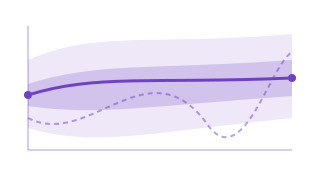
Infer, cluster, detect outliers, and test functional data.
The Analyze module collects the tools you reach for once your curves are represented and aligned: find groups via clustering, flag anomalous observations, construct tolerance bands, test whether two populations are equivalent, decompose seasonal patterns, and explore covariance structure. Every algorithm runs in Rust for maximum throughput.
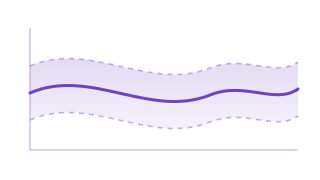
Tolerance Bands
FPCA-based tolerance bands, conformal bands, and Degras SCBs.
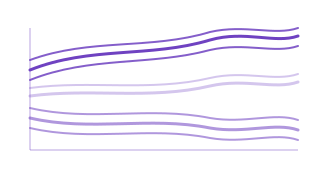
Clustering
K-means, fuzzy c-means, and GMM clustering for functional data.
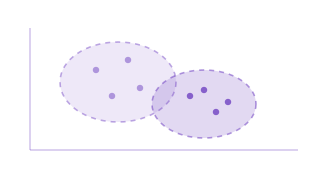
GMM Clustering
Model-based clustering with Gaussian mixtures and soft assignments.
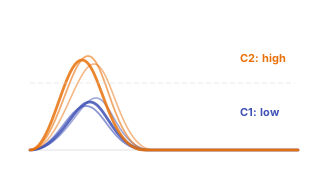
Elastic Clustering
Cluster by amplitude/phase-invariant elastic distance.
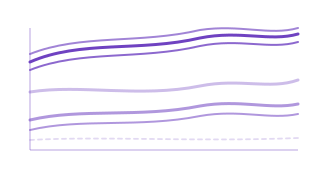
Advanced Clustering
Density-based, structure-aware, and alignment-coupled clustering methods.
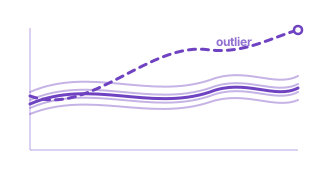
Outlier Detection
LRT, outliergram, and magnitude-shape anomaly detection.
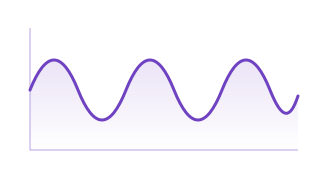
Seasonal Analysis
SAZED, autoperiod, STL, and peak detection for periodic data.
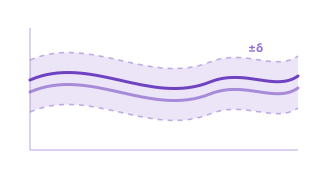
Equivalence Testing
TOST-based equivalence tests for functional means.
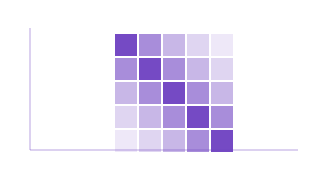
Covariance Functions
Gaussian, exponential, Matern, and periodic covariance kernels.
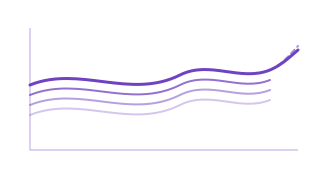
Functional Time Series
Forecast, test stationarity, and model autocorrelation for curve sequences.
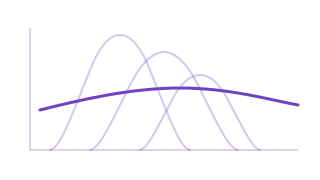
Density FDA
Analyze probability densities as functional objects via the LQD transform.
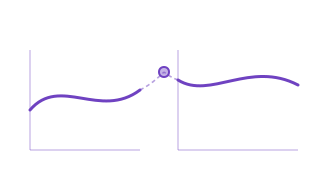
Multi-Domain FDA
Joint FPCA across multiple functional variables per subject.
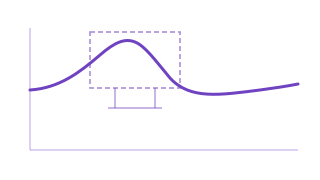
Shapelets
Discriminative subsequences that separate classes by minimum-distance matching.
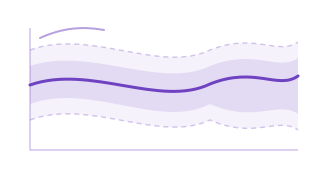
Functional Boxplot
Depth-based central region, fences, and outlier detection for curves.
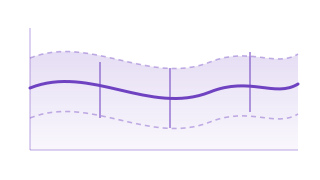
Functional Statistics
Pointwise variance, covariance surface, and depth-based median of curves.
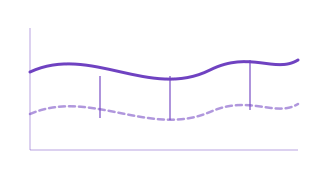
Scoring Metrics
Integrated prediction-error metrics: MAE, MSE, MAPE, MSLE, explained variance.