Working with Derivatives
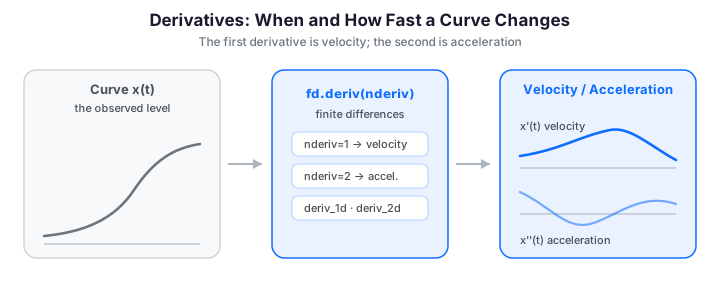
Derivatives of functional data expose information hidden inside the raw curves. The first derivative describes velocity -- the rate of change. The second derivative describes acceleration -- how the rate itself evolves -- and is tied to curvature and to the location of inflection points. Scientific questions are frequently about when and how fast something changes rather than about the observed level itself.
The Fdata class provides a deriv() convenience method for both 1D and 2D
functional data (the low-level functions deriv_1d and deriv_2d are still
available in fdars.fdata).
Notation
For a functional observation \(x_i(t)\), the \(r\)-th derivative is \(x_i^{(r)}(t) = \dfrac{d^r x_i}{dt^r}\). The first derivative \(x_i'(t)\) is the velocity; the second derivative \(x_i''(t)\) is the acceleration.
Loading Growth Data
The Berkeley Growth Study is the canonical dataset for demonstrating derivatives. Height curves show the overall growth trajectory; their first derivative (velocity) reveals the pubertal growth spurt as a peak; and the second derivative (acceleration) marks the onset and end of that spurt through its sign.
We load the girls' height curves (54 subjects measured at 31 ages) with the
docs_data helper:
from docs_data import load_growth
age, X, meta = load_growth() # age: (31,), X: (93, 31)
girls = X[meta["sex"].values == "female"] # (54, 31)
fd = Fdata(girls, argvals=age)
print(f"Loaded {fd.n_obs} growth curves from ages {age.min():.0f} to {age.max():.0f}")
# Loaded 54 growth curves from ages 1 to 18
Note that age is unequally spaced -- yearly up to age 8, then biannual.
deriv() uses the actual argvals spacing, so this is handled automatically.
The Problem: Noise Amplifies with Differentiation
Differentiation is a high-pass operation: small perturbations in the raw data translate into large fluctuations in the derivative. Naively differentiating noisy measurements therefore produces a wildly oscillating result that hides the true dynamics.
# Add measurement noise (sd = 1 cm) and differentiate directly
rng = np.random.default_rng(0)
noisy = girls + rng.normal(0, 1.0, size=girls.shape)
fd_noisy = Fdata(noisy, argvals=age)
fd_deriv_noisy = fd_noisy.deriv(nderiv=1) # velocity of the noisy curve
fd_deriv_clean = fd.deriv(nderiv=1) # velocity of the clean curve
The single-curve comparison below makes the effect obvious: the derivative of the raw noisy curve is jagged and untrustworthy, while the derivative of the underlying clean curve is smooth.
import numpy as np
from docs_fig import fig, render
from fdars import Fdata
from docs_data import load_growth
age, X, meta = load_growth()
girls = X[meta["sex"].values == "female"]
fd = Fdata(girls, argvals=age)
rng = np.random.default_rng(0)
noisy = girls + rng.normal(0, 1.0, size=girls.shape)
fd_noisy = Fdata(noisy, argvals=age)
v_clean = np.asarray(fd.deriv().data)[0]
v_noisy = np.asarray(fd_noisy.deriv().data)[0]
f, (a1, a2) = fig(1, 2, figsize=(9, 3.6), sharey=True)
a1.plot(age, v_clean, color="#198754", lw=2)
a1.set(title="Original data", xlabel="Age (years)", ylabel="Velocity (cm/year)")
a2.plot(age, v_noisy, color="#dc3545", lw=1.5)
a2.set(title="Noisy data", xlabel="Age (years)")
for a in (a1, a2):
a.axhline(0, color="#6c757d", lw=0.8)
f.suptitle("Effect of noise on derivative estimation")
print(render(f))
The clean velocity (left) is a smooth curve you could read a growth spurt off; the noisy velocity (right) swings violently between large positive and negative values that have nothing to do with real growth. A 1 cm perturbation in height has become tens of cm/year of spurious velocity -- the high-pass nature of differentiation in action.
Solution: Smooth Before Differentiating
The fundamental rule is: always smooth before you differentiate. In R this is
typically done with pspline(); in fdars the equivalent penalized-spline
smoother is pspline_fit_gcv / pspline_fit_1d (in fdars.basis), and the
convenient "smooth every curve at once" front-end is smooth_basis_gcv. All of
these fit a B-spline basis with a roughness penalty whose strength is chosen by
generalized cross-validation (GCV), producing curves that are smooth enough to
differentiate.
from fdars.basis import smooth_basis_gcv
# Smooth all noisy curves simultaneously, then differentiate the fitted curves
res = smooth_basis_gcv(noisy, age, n_basis=15)
fd_smooth = Fdata(np.asarray(res["fitted"]), argvals=age)
fd_velocity = fd_smooth.deriv(nderiv=1) # cm / year
fd_acceleration = fd_smooth.deriv(nderiv=2) # cm / year^2
Recommended pipeline
Smooth with smooth_basis_gcv (enough basis functions, GCV-chosen penalty),
then apply deriv() to the fitted Fdata. This gives the best balance of
speed, smoothness, and accuracy for most applications.
Understanding Growth Derivatives
A curve and its first two derivatives tell a layered story: zeros of the first derivative mark the extrema of the curve, and zeros of the second derivative mark its inflection points. For growth data this maps directly onto biology.
Height, Velocity, Acceleration
- Height -- the smoothed sigmoid growth trajectory.
- Velocity (\(x'\)) -- growth rate in cm/year. Infants grow fastest; the rate falls to roughly 5 cm/year in childhood, then a sharp pubertal peak appears around ages 11-13, after which growth approaches zero.
- Acceleration (\(x''\)) -- positive when growth is speeding up, negative when slowing down. The zero-crossing from positive to negative marks the age of peak velocity; the deep negative trough is the most rapid deceleration.
import numpy as np
from docs_fig import fig, render
from fdars import Fdata
from fdars.basis import smooth_basis_gcv
from docs_data import load_growth
age, X, meta = load_growth()
girls = X[meta["sex"].values == "female"]
res = smooth_basis_gcv(girls, age, n_basis=15)
fd_sm = Fdata(np.asarray(res["fitted"]), argvals=age)
vel = np.asarray(fd_sm.deriv(1).data)
acc = np.asarray(fd_sm.deriv(2).data)
hgt = np.asarray(fd_sm.data)
f, (a1, a2, a3) = fig(1, 3, figsize=(11, 3.6))
for i in range(hgt.shape[0]):
a1.plot(age, hgt[i], color="#3f51b5", lw=0.6, alpha=0.4)
a2.plot(age, vel[i], color="#e8710a", lw=0.6, alpha=0.4)
a3.plot(age, acc[i], color="#198754", lw=0.6, alpha=0.4)
a1.set(title="Height", xlabel="Age (years)", ylabel="Height (cm)")
a2.set(title="Velocity (1st derivative)", xlabel="Age (years)", ylabel="cm / year")
a3.set(title="Acceleration (2nd derivative)", xlabel="Age (years)", ylabel="cm / year$^2$")
a2.axhline(0, color="#6c757d", lw=0.8, ls="--")
a3.axhline(0, color="#6c757d", lw=0.8, ls="--")
print(render(f))
Every velocity curve shows the same qualitative shape -- a high infant rate, a childhood plateau, and a pronounced pubertal spurt -- but the timing of the spurt varies from child to child. Quantifying that timing is the next step.
Finding Important Events: Peak Height Velocity
The age at peak height velocity (PHV) is a standard marker of developmental maturity. Because velocity is also very high in infancy, we restrict the search to the pubertal range (\(\text{age} \ge 8\)) so we find the pubertal spurt rather than the early-childhood peak.
# Age of maximum velocity within the pubertal window, per child
pubertal = np.where(age >= 8)[0]
phv_ages = np.array([
age[pubertal[np.argmax(vel[i][pubertal])]]
for i in range(vel.shape[0])
])
print(f"Mean PHV: {phv_ages.mean():.1f} years")
print(f"SD: {phv_ages.std(ddof=1):.1f} years")
print(f"Range: {phv_ages.min():.1f} - {phv_ages.max():.1f} years")
# Mean PHV: 11.4 years (SD 1.1, range 9.5 - 14.0)
The mean PHV of ~11.4 years for girls matches the well-established biology, and the spread of roughly two years reflects genuine inter-individual variation in developmental timing.
import numpy as np
from docs_fig import fig, render
from fdars import Fdata
from fdars.basis import smooth_basis_gcv
from docs_data import load_growth
age, X, meta = load_growth()
girls = X[meta["sex"].values == "female"]
res = smooth_basis_gcv(girls, age, n_basis=15)
fd_sm = Fdata(np.asarray(res["fitted"]), argvals=age)
vel = np.asarray(fd_sm.deriv(1).data)
pubertal = np.where(age >= 8)[0]
phv = np.array([age[pubertal[np.argmax(vel[i][pubertal])]] for i in range(vel.shape[0])])
f, ax = fig(figsize=(7, 3.8))
ax.hist(phv, bins=10, color="#a9c8e8", edgecolor="white")
ax.axvline(phv.mean(), color="#dc3545", lw=2, label=f"mean = {phv.mean():.1f} yr")
ax.set(title="Distribution of PHV ages (girls)", xlabel="Age at PHV (years)", ylabel="Count")
ax.legend()
print(render(f))
The histogram peaks near the red mean around 11.4 years but spreads across roughly 9.5 to 14 years -- the derivative has turned each smooth height curve into a single interpretable number (age at peak velocity), and its spread quantifies genuine variation in developmental timing across children.
Early vs Median vs Late Developers
Contrasting an early, a median, and a late developer shows how developmental timing shifts the whole velocity peak along the age axis, even when the final adult heights are similar.
import numpy as np
from docs_fig import fig, render
from fdars import Fdata
from fdars.basis import smooth_basis_gcv
from docs_data import load_growth
age, X, meta = load_growth()
girls = X[meta["sex"].values == "female"]
res = smooth_basis_gcv(girls, age, n_basis=15)
fd_sm = Fdata(np.asarray(res["fitted"]), argvals=age)
hgt = np.asarray(fd_sm.data)
vel = np.asarray(fd_sm.deriv(1).data)
pubertal = np.where(age >= 8)[0]
phv = np.array([age[pubertal[np.argmax(vel[i][pubertal])]] for i in range(vel.shape[0])])
early, late = int(np.argmin(phv)), int(np.argmax(phv))
median = int(np.argmin(np.abs(phv - np.median(phv))))
idx = {"Early": early, "Median": median, "Late": late}
colors = {"Early": "#0072B2", "Median": "#6c757d", "Late": "#D55E00"}
f, (a1, a2) = fig(1, 2, figsize=(9, 3.8))
for name, i in idx.items():
a1.plot(age, hgt[i], color=colors[name], lw=2, label=name)
a2.plot(age, vel[i], color=colors[name], lw=2, label=name)
a1.set(title="Height", xlabel="Age (years)", ylabel="Height (cm)")
a2.set(title="Velocity", xlabel="Age (years)", ylabel="cm / year")
a2.axhline(0, color="#6c757d", lw=0.8, ls="--")
a1.legend(); a2.legend()
print(render(f))
The three height curves (left) are nearly indistinguishable in their adult plateau, yet the velocity curves (right) show their peaks sliding several years apart along the age axis. This is the payoff of differentiation: a feature invisible in the raw curves -- developmental timing -- becomes the dominant, easily-read signal in the derivative.
Derivative-Based Distances
Two children may reach similar final heights yet grow very differently. Comparing the shapes of their velocity or acceleration curves often captures growth dynamics better than comparing raw heights.
Formally, the derivative semimetric of order \(r\) is the \(L^2\) distance between the \(r\)-th derivatives of the two curves,
so \(r = 0\) is the ordinary \(L^2\) distance on heights, \(r = 1\) compares velocities,
and \(r = 2\) compares accelerations. R exposes this through
semimetric.deriv(fd, nderiv=r). fdars has no single function with that name, but
the same quantity is obtained directly: differentiate first, then take an \(L^2\)
distance on the derivative curves with lp_self_1d (or, equivalently,
Fdata.distance(method="lp") on the derivative Fdata).
from fdars.metric import lp_self_1d
d_height = np.asarray(lp_self_1d(np.asarray(fd_sm.data), age)) # L2 on height
d_velocity = np.asarray(lp_self_1d(np.asarray(fd_sm.deriv(1).data), age)) # L2 on velocity
d_acceleration = np.asarray(lp_self_1d(np.asarray(fd_sm.deriv(2).data), age)) # L2 on acceleration
sub = np.s_[:10, :10]
print("Height vs Velocity: ",
round(np.corrcoef(d_height[sub].ravel(), d_velocity[sub].ravel())[0, 1], 3))
print("Height vs Acceleration:",
round(np.corrcoef(d_height[sub].ravel(), d_acceleration[sub].ravel())[0, 1], 3))
# Height vs Velocity: 0.699
# Height vs Acceleration: 0.442
The moderate (not perfect) correlation confirms that derivative-based distances capture a distinct aspect of growth: two curves close in height need not be close in velocity.
Clustering by Growth Dynamics
Feeding the velocity curves into kmeans_fd groups children by growth
dynamics rather than by final height.
import numpy as np
from docs_fig import fig, render
from fdars import Fdata
from fdars.basis import smooth_basis_gcv
from fdars.clustering import kmeans_fd
from docs_data import load_growth
age, X, meta = load_growth()
girls = X[meta["sex"].values == "female"]
res = smooth_basis_gcv(girls, age, n_basis=15)
fd_sm = Fdata(np.asarray(res["fitted"]), argvals=age)
hgt = np.asarray(fd_sm.data)
vel = np.asarray(fd_sm.deriv(1).data)
km = kmeans_fd(vel, age, k=2, seed=123) # cluster on velocity curves
labels = np.asarray(km["cluster"])
palette = {0: "#0072B2", 1: "#D55E00"}
f, (a1, a2) = fig(1, 2, figsize=(9, 3.8))
for i in range(hgt.shape[0]):
c = palette[int(labels[i])]
a1.plot(age, hgt[i], color=c, lw=0.6, alpha=0.5)
a2.plot(age, vel[i], color=c, lw=0.6, alpha=0.5)
a1.set(title="Height (colored by velocity cluster)", xlabel="Age (years)", ylabel="Height (cm)")
a2.set(title="Velocity by cluster", xlabel="Age (years)", ylabel="cm / year")
a2.axhline(0, color="#6c757d", lw=0.8, ls="--")
print(render(f))
The two clusters separate mainly by the timing and sharpness of the pubertal spurt -- something a height-only distance would largely miss.
Higher-Order Derivatives
Use the nderiv parameter to compute second, third, or higher derivatives in a
single call:
fd_d2 = fd_sm.deriv(nderiv=2) # acceleration / curvature
fd_d3 = fd_sm.deriv(nderiv=3) # jerk
print(fd_d2.shape) # (54, 31)
Numerical instability
Each successive derivative amplifies noise further. On raw noisy data, third- and higher-order derivatives quickly become meaningless -- smoothing first is not optional at these orders.
2D Functional Data: Partial Derivatives
For functional data observed on a 2D domain -- surfaces \(x_i(s, t)\), e.g.
temperature over space and time -- deriv() returns the two first-order partial
derivatives plus the mixed partial.
A 2D observation is stored as a flattened row of shape (m1 * m2,); a dataset is
(n_obs, m1 * m2). The evaluation grid is passed as a tuple (argvals_s, argvals_t).
import numpy as np
from docs_fig import fig, render
from fdars import Fdata
m1, m2 = 20, 25
s = np.linspace(0, 1, m1)
t = np.linspace(0, 1, m2)
S, T = np.meshgrid(s, t, indexing="ij")
# A single wave-pattern surface: sin(2*pi*s) * cos(2*pi*t)
Z = (np.sin(2 * np.pi * S) * np.cos(2 * np.pi * T)).ravel()[None, :]
fd2d = Fdata(Z, argvals=(s, t))
fd_ds, fd_dt, fd_dsdt = fd2d.deriv() # three Fdata objects
surf = np.asarray(fd2d.data)[0].reshape(m1, m2)
d_ds = np.asarray(fd_ds.data)[0].reshape(m1, m2)
d_dt = np.asarray(fd_dt.data)[0].reshape(m1, m2)
f, (a1, a2, a3) = fig(1, 3, figsize=(11, 3.4))
kw = dict(origin="lower", extent=[0, 1, 0, 1], aspect="auto", cmap="coolwarm")
a1.imshow(surf, **kw); a1.set(title="$x(s,t)$", xlabel="t", ylabel="s")
a2.imshow(d_ds, **kw); a2.set(title=r"$\partial x/\partial s$", xlabel="t")
a3.imshow(d_dt, **kw); a3.set(title=r"$\partial x/\partial t$", xlabel="t")
print(render(f))
The three returned arrays are:
| Array | Meaning |
|---|---|
fd_ds |
\(\partial x_i / \partial s\) -- partial derivative w.r.t. the first dimension |
fd_dt |
\(\partial x_i / \partial t\) -- partial derivative w.r.t. the second dimension |
fd_dsdt |
\(\partial^2 x_i / \partial s\, \partial t\) -- mixed partial derivative |
Reshape any single surface back to the grid with .reshape(m1, m2) for inspection
or plotting.
Accuracy of the Derivative
deriv() uses central finite differences. On the interior of a uniform grid
the first derivative at \(t_j\) is estimated from the two neighbouring samples,
which is second-order accurate -- the leading error term scales as the square of the grid spacing \(h\), so halving \(h\) cuts the error by roughly four. On a smooth analytic function it recovers the true derivative to a few parts in a thousand:
import numpy as np
from docs_fig import fig, render
from fdars import Fdata
t = np.linspace(0, 2 * np.pi, 50)
f_vals = np.sin(t)
f_true = np.cos(t) # analytic derivative
fd = Fdata(f_vals[None, :], argvals=t)
d_est = np.asarray(fd.deriv().data)[0]
err = np.max(np.abs(d_est - f_true))
# Validation against a KNOWN ground truth: (sin)' = cos exactly.
# 1. The central-difference estimate must match cos to a few parts in a thousand
# on this 50-point grid (interior error is O(h^2)).
interior = slice(1, -1) # endpoints use one-sided stencils
err_interior = np.max(np.abs(d_est[interior] - f_true[interior]))
assert err_interior < 1e-2, f"derivative off ground truth: {err_interior:.4f}"
# 2. O(h^2) accuracy: halving the grid spacing must cut the interior error by ~4x.
def interior_err(m):
tt = np.linspace(0, 2 * np.pi, m)
de = np.asarray(Fdata(np.sin(tt)[None, :], argvals=tt).deriv().data)[0]
return np.max(np.abs(de[1:-1] - np.cos(tt)[1:-1]))
e_coarse, e_fine = interior_err(40), interior_err(80) # h -> h/2 (approx)
ratio = e_coarse / e_fine
assert ratio > 3.0, f"error did not shrink ~4x under grid refinement (ratio {ratio:.2f})"
print(f"max interior error = {err_interior:.5f} (ground truth: (sin)'=cos)")
print(f"error ratio coarse/fine = {ratio:.2f} (expected ~4 for O(h^2))")
g, ax = fig(figsize=(7, 3.8))
ax.plot(t, f_true, color="black", lw=2, label="true $\\cos t$")
ax.plot(t, d_est, color="#D55E00", lw=1.6, ls="--", label="deriv() [central diff]")
ax.set(title=f"Central-difference derivative (max error = {err:.4f})",
xlabel="t", ylabel="f'(t)")
ax.legend()
print(render(g))
The two asserts turn the O(\(h^2\)) claim into a checked fact: the estimate matches the analytic \(\cos t\) to a few parts in a thousand on the interior, and halving the grid spacing shrinks that error by roughly \(4\times\) -- the signature of second-order accuracy.
No 5-point gradient binding yet
The R package additionally offers fdata.gradient(), a 5-point-stencil
gradient that is \(O(h^4)\) accurate on uniform grids. fdars does not currently
expose an equivalent, so for maximum first-derivative accuracy the practical
lever in Python is smoothing quality (basis choice and penalty) rather
than the stencil. For most work the \(O(h^2)\) central differences of deriv()
are more than adequate, and higher-order derivatives (order 2+) rely on them
directly.
Optimal Smoothing for Derivatives
When the derivative -- not the fitted curve -- is the target, the best amount of smoothing is often more than what is optimal for fitting the curve itself. Under-smoothing leaves noise that the derivative amplifies; a larger penalty \(\lambda\) trades a little curve bias for a much cleaner derivative.
The sweep below fits one noisy curve at several penalty levels with
pspline_fit_1d (which takes an explicit lambda_) and differentiates each fit.
As \(\lambda\) grows, the velocity estimate becomes progressively smoother.
import numpy as np
from docs_fig import fig, render
from fdars import Fdata
from fdars.basis import pspline_fit_1d
from docs_data import load_growth
age, X, meta = load_growth()
girls = X[meta["sex"].values == "female"]
rng = np.random.default_rng(0)
noisy1 = (girls[0] + rng.normal(0, 1.0, size=girls.shape[1]))[None, :] # one noisy curve
# lightly-smoothed reference derivative
ref = np.asarray(Fdata(np.asarray(pspline_fit_1d(girls[0][None, :], age,
n_basis=15, lambda_=0.1)["fitted"]),
argvals=age).deriv().data)[0]
lambdas = [0.01, 0.1, 1.0, 10.0]
f, axes = fig(2, 2, figsize=(9, 6), sharex=True, sharey=True)
for lam, ax in zip(lambdas, axes.ravel()):
fit = pspline_fit_1d(noisy1, age, n_basis=15, lambda_=lam)
v = np.asarray(Fdata(np.asarray(fit["fitted"]), argvals=age).deriv().data)[0]
ax.plot(age, v, color="#0072B2", lw=2, label="smoothed")
ax.plot(age, ref, color="#D55E00", lw=1.4, ls="--", label="reference")
ax.axhline(0, color="#6c757d", lw=0.8, ls=":")
ax.set(title=f"$\\lambda$ = {lam}")
axes[1, 0].set(xlabel="Age (years)", ylabel="Velocity (cm/year)")
axes[0, 0].legend(fontsize=8)
print(render(f))
At very small \(\lambda\) the derivative chases the noise; by \(\lambda = 1\) the
velocity estimate is clean yet still tracks the reference's pubertal peak near
age 10. Push the penalty too far, however, and it over-smooths: at
\(\lambda = 10\) the spurt has been flattened away entirely, leaving a monotone
decline that no longer matches the biology. The sweet spot for a derivative
therefore sits between under- and over-smoothing -- here around \(\lambda = 1\).
In practice, let smooth_basis_gcv pick the penalty and nudge it up only if the
derivative still looks rough.
Practical Workflow
A systematic recipe for robust derivative analysis:
import numpy as np
from fdars import Fdata
from fdars.basis import smooth_basis_gcv
from docs_data import load_growth
# 1. Load and inspect the raw data
age, X, meta = load_growth()
girls = X[meta["sex"].values == "female"]
fd = Fdata(girls, argvals=age)
print(fd.summary())
# 2. Smooth (penalized B-splines, GCV-chosen penalty)
res = smooth_basis_gcv(girls, age, n_basis=15)
fd_smooth = Fdata(np.asarray(res["fitted"]), argvals=age)
# 3. Compute derivatives from the smoothed curves
fd_d1 = fd_smooth.deriv(nderiv=1)
fd_d2 = fd_smooth.deriv(nderiv=2)
v = np.asarray(fd_d1.data)
a = np.asarray(fd_d2.data)
# 4. Extract features from the derivatives
pubertal = np.where(age >= 8)[0]
features = {
"max_velocity": v.max(axis=1),
"age_at_max_vel": np.array([age[pubertal[np.argmax(v[i][pubertal])]]
for i in range(v.shape[0])]),
"min_acceleration": a.min(axis=1),
}
# 5. Use the features for downstream analysis
r = np.corrcoef(features["age_at_max_vel"], features["max_velocity"])[0, 1]
print(f"Correlation between age at PHV and max velocity: {r:.3f}")
Summary
| Task | Function | Notes |
|---|---|---|
| First derivative | fd.deriv(nderiv=1) |
Velocity / rate of change; central differences, \(O(h^2)\) |
| Second derivative | fd.deriv(nderiv=2) |
Acceleration / curvature |
| 2D partials | fd.deriv() (2D) |
Returns (fd_ds, fd_dt, fd_dsdt) |
| Low-level 1D | deriv_1d(data, argvals, nderiv=1) |
fdars.fdata; raw 2D array in, array out |
| Low-level 2D | deriv_2d(data, argvals_s, argvals_t) |
fdars.fdata; partials of raw 2D data |
| Pre-smoothing (all curves) | smooth_basis_gcv(data, argvals, n_basis) |
fdars.basis; GCV penalty |
| Pre-smoothing (explicit \(\lambda\)) | pspline_fit_1d(data, argvals, n_basis, lambda_) |
fdars.basis |
| Derivative distance | lp_self_1d on deriv() output |
Shape-based comparison (R's semimetric.deriv) |
| Cluster on dynamics | kmeans_fd(deriv_data, argvals, k) |
fdars.clustering |
Key takeaways:
- Always smooth before differentiating -- differentiation amplifies noise.
- Derivatives may want more smoothing than the curve fit itself.
- Derivatives reveal dynamics -- growth spurts, developmental timing, phase.
- Derivative-based distances enable shape-based clustering and comparison.
References
- Ramsay, J. O. & Silverman, B. W. (2005). Functional Data Analysis (2nd ed.). Springer. (Ch. 5, Smoothing Functional Data; Ch. 19, Principal Differential Analysis.)
- Ramsay, J. O. (1996). Principal Differential Analysis: Data Reduction by Differential Operators. Journal of the Royal Statistical Society, Series B, 58(3), 495--508.
- Tuddenham, R. D. & Snyder, M. M. (1954). Physical Growth of California Boys and Girls from Birth to Eighteen Years. University of California Publications in Child Development, 1(2), 183--364.
- Fan, J. & Gijbels, I. (1996). Local Polynomial Modelling and Its Applications. Chapman & Hall.
Next Steps
- Smoothing -- choose the right smoother before differentiating.
- Functional PCA -- decompose derivatives into principal components.
- Basis Representation -- smooth with basis expansions for optimal pre-processing.