Represent
Decompose, transform, rank, and measure functional data.
The Represent module brings together the core tools for analyzing functional data beyond simple summary statistics. Whether you need to extract the dominant modes of variation, project curves onto a finite basis, rank observations by their centrality, or quantify how different two functional samples are, this section has you covered.
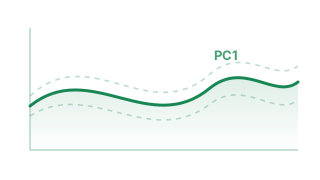
Functional PCA
Extract dominant modes of variation with weighted FPCA.
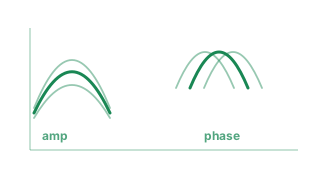
Elastic FPCA
Separate amplitude and phase with horizontal, vertical, and joint FPCA.
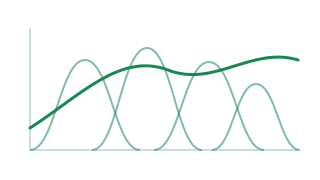
Basis Representation
B-spline, Fourier, and P-spline expansions with automatic selection.
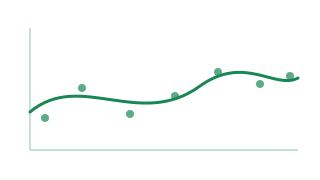
PACE FPCA
FPCA via conditional expectation for sparse, irregularly sampled curves.
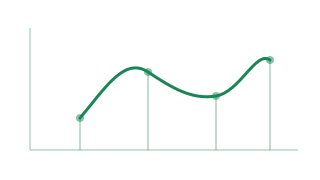
Spline Interpolation
Resample functional curves onto any grid with B-spline fits.
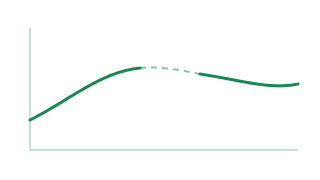
Missing Value Imputation
Fill NaN gaps in functional curves with spline or mean strategies.
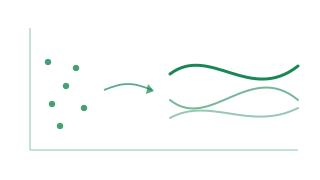
Andrews Transformation
Turn multivariate tables into curves for visual exploration.
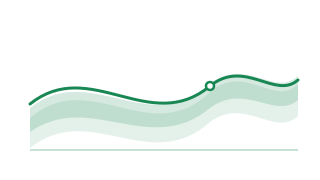
Depth Functions
Fraiman-Muniz, band, modal, random projection, Tukey, and spatial depth.
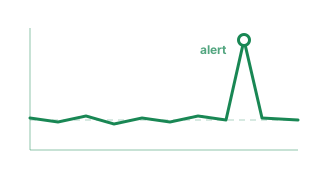
Streaming Depth
Flag out-of-distribution curves online against a reference window.
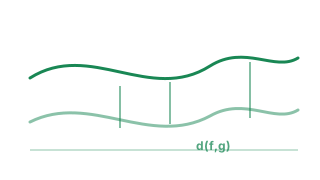
Distance Metrics
Lp, Hausdorff, DTW, Soft-DTW, Fourier, and horizontal-shift distances.
Scope & limitations
The Represent tools assume real-valued functions sampled on a single shared grid. Keep these boundaries in mind:
- FPCA and basis representation are linear. They fit the best linear subspace of \(L^2\) and assume the data lies near it. Strong nonlinear or phase (warping) variation is captured poorly — use Elastic FPCA (align first, then separate amplitude and phase) instead.
- Basis systems are B-spline and Fourier only (with optional P-spline penalization); there are no density-specific bases.
- Constrained-range or density data is not supported. Data that must stay nonnegative, integrate to 1, or remain bounded/monotone can be pushed out of its valid range by linear FPCA and means — transform to an unconstrained space (e.g. CLR or log-quantile-density) first.
- Sparse or irregular per-curve sampling is not supported. Pre-smooth each curve onto the common grid first.
- Manifold-valued data is out of scope.