Transformers
Eight TransformerMixin estimators map raw functional data (n_obs, n_points) to
preprocessed or reduced representations — cleaning, smoothing, re-representing, and
projecting curves so downstream predictors receive well-conditioned numeric matrices.
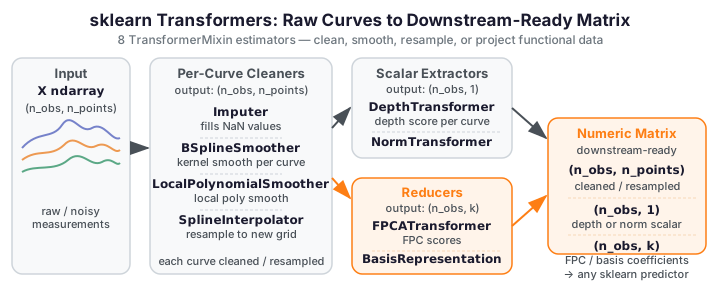
The transformers are the workhorse of any functional-data Pipeline. A typical
chain starts with Imputer to fill measurement gaps, follows with a smoother to
reduce noise, and ends with FPCATransformer to project curves onto their leading
functional principal components — producing an (n_obs, n_components) score matrix
that any sklearn classifier or regressor can consume directly.
See the coverage / EXCLUDE list for the full 28-estimator wrapped set and all structural exclusions.
Estimator Reference
| Estimator | sklearn mixin | fdars source | Key constructor params |
|---|---|---|---|
FPCATransformer |
TransformerMixin |
fdars._native.regression.fpca |
n_components=3, argvals=None |
BSplineSmoother |
TransformerMixin |
fdars._native.smoothing.nadaraya_watson |
bandwidth=None, kernel="gaussian", argvals=None |
LocalPolynomialSmoother |
TransformerMixin |
fdars._native.smoothing.local_polynomial |
bandwidth=None, degree=1, kernel="gaussian", argvals=None |
BasisRepresentation |
TransformerMixin |
fdars._native.basis.fdata_to_basis_1d |
n_basis=5, basis_type="bspline", argvals=None |
Imputer |
TransformerMixin |
fdars._native.fdata (interpolation) |
method="linear", constant_value=0.0, argvals=None |
SplineInterpolator |
TransformerMixin |
fdars._native.represent.spline_interpolate |
output_argvals=None, order=3, argvals=None |
DepthTransformer |
TransformerMixin |
fdars._native.depth.fraiman_muniz_1d |
depth_method="fraiman_muniz", scale=True, argvals=None |
NormTransformer |
TransformerMixin |
fdars._native.fdata.norm_lp_1d |
p=2.0, argvals=None |
Estimator Details
FPCATransformer
Role in a Pipeline: the dimensionality-reduction hub. Maps
(n_obs, n_points) → (n_obs, n_components) functional principal component
scores. The fit call computes the FPC basis via SVD with sign canonicalization
(the largest absolute value in each eigenvector is made positive), making fit
idempotent across re-runs on the same data. The output score matrix feeds any
sklearn classifier, regressor, or clustering estimator without adaptation.
BSplineSmoother
Per-curve B-spline / Nadaraya-Watson kernel smoother. Applies smoothing
row-by-row so each observed curve is smoothed independently against its own
evaluation grid. bandwidth=None activates automatic bandwidth selection via
the native heuristic.
from fdars.sklearn._skeletons import BSplineSmoother
smoother = BSplineSmoother(bandwidth=0.2, kernel="gaussian")
LocalPolynomialSmoother
Per-curve local-polynomial kernel smoother. A polynomial of degree degree
is fit locally at each evaluation point using a kernel-weighted neighbourhood.
Useful when curves have local trend features that B-spline smoothing over-smooths.
from fdars.sklearn._skeletons import LocalPolynomialSmoother
lps = LocalPolynomialSmoother(degree=2, bandwidth=0.15)
BasisRepresentation
Projects each curve onto a B-spline basis of n_basis elements and returns the
expansion coefficients as the transformed matrix. Output shape is
(n_obs, n_basis). A 1-feature guard prevents the native call from receiving
degenerate single-column inputs.
from fdars.sklearn._skeletons import BasisRepresentation
basis = BasisRepresentation(n_basis=8, basis_type="bspline")
Imputer
Linear-interpolation imputation of NaN values in the raw curve matrix. Each
curve is imputed independently; boundary NaNs are forward/backward filled.
Place Imputer first in any Pipeline when measurement gaps are expected.
SplineInterpolator
Resamples each curve from its current argvals grid onto a new output_argvals
grid using spline interpolation of order order (default 3, cubic). Useful for
harmonising irregular or mis-aligned grids before downstream estimators that
expect a fixed grid.
from fdars.sklearn._skeletons import SplineInterpolator
interp = SplineInterpolator(output_argvals=np.linspace(0, 1, 50), order=3)
DepthTransformer
Maps each curve to a single scalar: its modified band-depth (or the depth
function named by depth_method). Output shape is (n_obs, 1). Useful for
constructing a depth-based feature column that feeds a standard scalar
classifier or for downstream outlier ranking.
from fdars.sklearn._skeletons import DepthTransformer
dt = DepthTransformer(depth_method="fraiman_muniz", scale=True)
NormTransformer
Maps each curve to its L^p norm scalar. Output shape is (n_obs, 1). With
p=2.0 (default) this is the functional L² norm; p=1.0 gives the L¹ norm.
A lightweight feature extractor when only global curve magnitude matters.
Typical Pipeline
from sklearn.pipeline import Pipeline
from fdars.sklearn._skeletons import Imputer, BSplineSmoother, FPCATransformer, FPCLDAClassifier

pipe = Pipeline([
    ("imputer",  Imputer()),
    ("smoother", BSplineSmoother()),
    ("fpca",     FPCATransformer(n_components=4)),
    ("clf",      FPCLDAClassifier()),
])
The transformer chain is order-sensitive by design — the output of each step must match the input contract of the next. See the concept overview on sklearn/index.md for the plain-ndarray contract.