Pipeline Diagnostic Report
A typical FDA workflow is a multi-stage pipeline: represent the raw data, smooth or align curves, decompose with FPCA, then cluster or regress. Diagnostics from each stage provide complementary information — and issues upstream (high missingness, many outliers, low cumulative variance) propagate silently into downstream results unless they are surfaced explicitly.
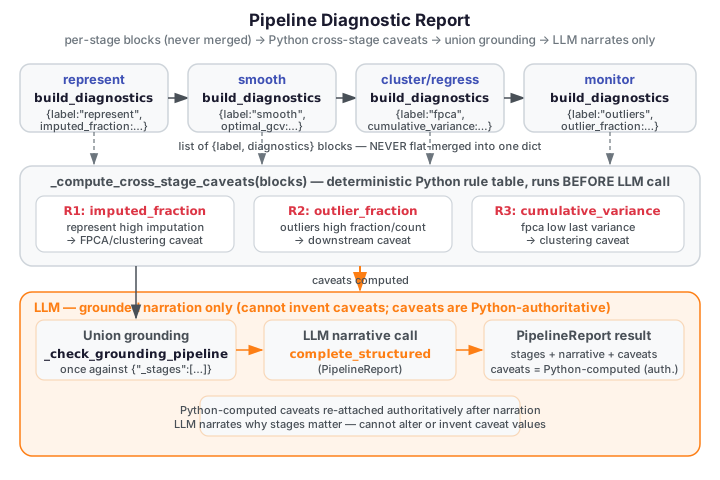
The pipeline diagnostic report aggregates per-stage diagnostics into an ordered, labeled report. Cross-stage caveats are computed by deterministic Python rules before any LLM call — the LLM narrates them but never invents them.
Method
build_pipeline_report accepts an ordered list of stage entries, runs build_diagnostics
per stage (or accepts pre-built diagnostics dicts), and returns per-stage labeled blocks.
Aggregation invariant: Each stage's diagnostics live in their own labeled block —
{"stage": str, "aspect": str, "diagnostics": dict}. They are never flat-merged. Two
stages that share a key (e.g. n_obs) both survive with their individual values. A plain
dict.update or {**a, **b} would silently overwrite earlier values; this is prevented by
the list structure.
Python-computed cross-stage caveats (PIPE-03): Three deterministic rules fire before the LLM call:
| Rule | Trigger | Caveat |
|---|---|---|
| R1 | represent stage: imputed_fraction > 0.20 |
High imputation rate may bias FPCA and clustering |
| R2 | outliers stage: derived outlier fraction > 0.15 |
Substantial outlier rate distorts downstream FPCA, clustering, regression |
| R3 | fpca stage: last cumulative_variance_explained < 0.80 |
Subspace captures too little variance for reliable clustering |
These caveats are authoritative — the LLM only narrates them; it cannot invent additional caveats beyond these Python-computed ones.
Union grounding: Grounding is checked once against the union of all stages' diagnostics
({"_stages": [<diag>, ...]}). A cited value is grounded when it appears in any stage's
diagnostics, allowing legitimate cross-stage narration (e.g. citing FPCA cumulative
variance in the context of a clustering caveat) without false rejection.
Worked example
The fence below builds a synthetic three-stage pipeline (represent → fpca → clustering)
and runs the offline pipeline report. No ANTHROPIC_API_KEY is needed — the fence runs
fully offline in the docs build.
import numpy as np
from fdars.advisor import build_diagnostics, build_pipeline_report

# Small synthetic data (n=12 observations, m=50 grid points)
rng = np.random.default_rng(7)
n, m = 12, 50
t = np.linspace(0, 1, m)
X = np.array([np.sin(2 * np.pi * t + rng.uniform(-0.3, 0.3)) for _ in range(n)])

# Stage 1: represent diagnostics (pre-built)
diag_represent = {
    "method": "represent",
    "n_obs": n,
    "n_points": m,
    "argvals_min": 0.0,
    "argvals_max": 1.0,
    "argvals_spacing_mean": 1.0 / (m - 1),
    "argvals_spacing_std": 0.0,
    "is_uniform_grid": True,
    "data_range_min": float(X.min()),
    "data_range_max": float(X.max()),
    "data_range_mean": float(X.mean()),
    "nan_frac": None,
    "has_boundary_nans": None,
    "imputation_method": None,
    "imputed_fraction": None,
}

# Stage 2: FPCA diagnostics (pre-built)
from fdars import regression
fp = regression.fpca(X, t, n_comp=3)
diag_fpca = build_diagnostics(fp, method="fpca")

# Stage 3: clustering diagnostics (pre-built)
from fdars.clustering import kmeans_fd
cl = kmeans_fd(X, t, k=3, seed=0)
diag_cluster = build_diagnostics(cl, method="clustering", argvals=t)

stages = [
    {"stage_name": "represent", "aspect": "represent", "diagnostics": diag_represent},
    {"stage_name": "fpca",      "aspect": "fpca",      "diagnostics": diag_fpca},
    {"stage_name": "cluster",   "aspect": "clustering", "diagnostics": diag_cluster},
]

report = build_pipeline_report(stages, run_llm=False)

for block in report["stages"]:
    stage = block["stage"]
    aspect = block["aspect"]
    diag = block["diagnostics"]
    if aspect == "fpca":
        cv = diag["cumulative_variance_explained"]
        print(f"Stage '{stage}': cumulative_variance_explained[-1]={cv[-1]:.4f}")
    elif aspect == "clustering":
        amp = diag["mean_amplitude_separation"]
        print(f"Stage '{stage}': mean_amplitude_separation={amp:.4f}")
    else:
        print(f"Stage '{stage}': n_obs={diag['n_obs']}, is_uniform_grid={diag['is_uniform_grid']}")

print("cross_stage_caveats:", len(report.get("caveats", [])))
print("FDARS_FENCE_OK")
Functions
build_pipeline_report
build_pipeline_report(stages, *, argvals=None, run_llm=True,
                      domain_context="", model="claude-opus-4-8",
                      provider=None, **kwargs) -> dict
Aggregate per-stage diagnostics into an offline pipeline diagnostic report.
Stage entry schema: each entry in stages must be a dict with:
| Key | Type | Description |
|---|---|---|
"stage_name" |
str |
Human-readable label (e.g. "represent", "smooth", "fpca", "cluster") |
"aspect" |
str |
build_diagnostics aspect key for this stage |
"diagnostics" / "result" / "value" |
dict |
Pre-built diagnostics dict (has "method" key) or raw fdars result dict |
When the stage value is a pre-built diagnostics dict (has a "method" key), it is
passed through without re-running build_diagnostics. When it is a raw fdars result
dict, build_diagnostics(value, aspect, argvals=argvals, **kwargs) is called.
Parameters
| Parameter | Type | Default | Description |
|---|---|---|---|
stages |
list |
— | Ordered list of stage entry dicts |
argvals |
array_like |
None |
Shared evaluation grid forwarded to build_diagnostics (required for clustering/alignment aspects) |
run_llm |
bool |
True |
When False, return the raw aggregated dict of per-stage blocks offline |
domain_context |
str |
"" |
Free-text domain description forwarded to LLM narration (run_llm=True only) |
model |
str |
"claude-opus-4-8" |
LLM model identifier |
provider |
str or Provider or None |
None |
LLM provider |
Returns (offline, run_llm=False)
{
    "stages": [
        {"stage": <str>, "aspect": <str>, "diagnostics": <dict>},
        ...  # one labeled block per input stage, in caller order
    ]
}
Returns (LLM path, run_llm=True)
PipelineReport — schema-validated object with:
| Field | Type | Description |
|---|---|---|
stages |
list[str] |
Per-stage narrative sections (one per input stage) |
narrative |
str |
Overall pipeline health summary |
caveats |
list[dict] |
Python-computed cross-stage caveats (authoritative) |
Raises
ValueError—stagesis empty, or a stage entry is missing"stage_name"or"aspect".GroundingViolationError— whenrun_llm=Trueand the narration cites a value absent from all stages' diagnostics.
pipeline_report
pipeline_report(stages, *, argvals=None, domain_context="",
                model="claude-opus-4-8", provider=None,
                thresholds=None, **kwargs) -> PipelineReport
LLM narrative entry point — called automatically by build_pipeline_report(run_llm=True).
Direct access is useful when you need custom caveat thresholds.
thresholds parameter: override any of the three Python caveat rule constants for
this call only:
| Key | Default | Rule |
|---|---|---|
"imputed_fraction" |
0.20 |
R1 threshold |
"outlier_fraction" |
0.15 |
R2 threshold |
"cumulative_variance" |
0.80 |
R3 threshold |
Caveats
Per-stage blocks are never merged. If two stages both report n_obs, both values
survive independently in their own list elements. A caller that flat-merges blocks (e.g.
{**a, **b}) risks silently dropping earlier values; use the labeled list structure instead.
Python caveats are authoritative; LLM caveats are not. The caveats field in the
returned PipelineReport always reflects the Python-computed R1/R2/R3 rules — even if
the LLM emitted different caveats. The LLM narrates what Python found; it cannot override.
argvals propagation. A shared argvals grid passed to build_pipeline_report is
forwarded to every build_diagnostics call for raw result dicts. For pre-built diagnostics
dicts it is ignored (they already carry the computed values). Distance-based metrics
(clustering, alignment) require argvals — pass it at the build_pipeline_report level
rather than per stage.
Ordering matters. Stages are processed in caller order; the LLM is told the stages represent a pipeline in sequence. Reordering stages changes the caveat computation (R1 and R3 can interact: a high imputation rate preceding a low-variance FPCA compounds the downstream clustering reliability concern).