Python API
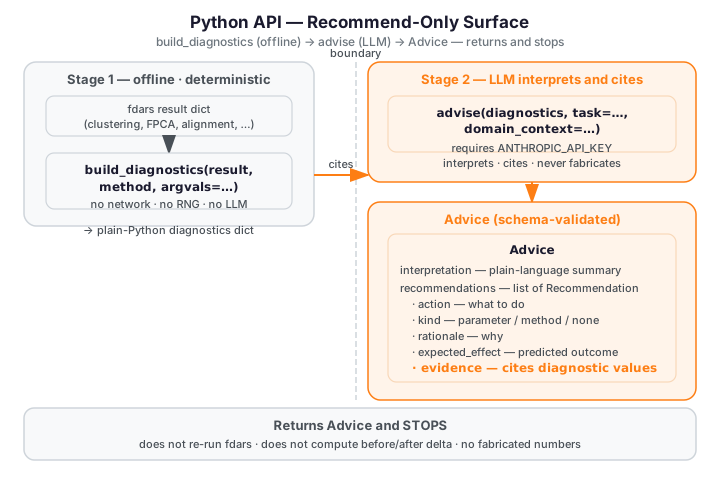
The Python advisor surface is recommend-only: call build_diagnostics to
compute a deterministic, offline diagnostics report from your fdars result, then
call advise (or the describe_cluster_differences convenience wrapper) to get
a schema-validated Advice object with interpretation, recommendations, and
caveats. The API returns Advice and stops — it does not re-run fdars or
compute a before/after delta. See the overview for the full picture.
Worked example
The fence below loads the Canadian Weather dataset, clusters the 35 daily
temperature curves into four groups with kmeans_fd, and builds the offline
cluster diagnostics with build_diagnostics. No ANTHROPIC_API_KEY is
required — the fence runs fully offline in the docs build.
from docs_data import load_canadian_weather
from fdars.clustering import kmeans_fd
from fdars.advisor import build_diagnostics

day, X, meta = load_canadian_weather("temperature")
result = kmeans_fd(X, day, k=4, seed=42)
diag = build_diagnostics(result, method="clustering", argvals=day)

print(f"k (clusters):              {diag['k']}")
print(f"cluster sizes:             {diag['cluster_sizes']}")
print(f"mean amplitude separation: {diag['mean_amplitude_separation']:.4f}  FDARS_FENCE_OK")
print(f"mean phase separation:     {diag['mean_phase_separation']:.4f}")
Functions
build_diagnostics
Compute a deterministic, JSON-serialisable diagnostics dict from an fdars result.
Offline and deterministic — uses only NumPy and fdars submodules. No
anthropic import, no network call, no RNG, no wall-clock dependency. Two calls
on the same input always return an equal dict.
Parameters
| Parameter | Type | Default | Description |
|---|---|---|---|
result |
dict or result wrapper |
— | Native fdars output dict, or a wrapper whose .raw attribute is the underlying dict |
method |
str |
— | The fdars method that produced result; one of "alignment", "fpca", "basis", "smoothing", "clustering", "depth", "outliers", "classification", "represent", "regression", "regression_cv", "spm" |
argvals |
array_like |
None |
Shared evaluation grid, shape (m,). Used for amplitude/phase distance computations |
n_classes |
int |
None |
Ground-truth class count for the "classification" aspect; cannot be inferred from a result dict, so the caller supplies it. Ignored by all other methods |
**kwargs |
Reserved for future per-method options |
Returns
A plain-Python dict with JSON-serialisable values (float, list, str,
bool, int, None). No NumPy scalars. Keys depend on method — see
Per-Aspect Coverage for the complete per-aspect key sets. A
summary of the most commonly used aspects:
"clustering"—k,cluster_means,cluster_sizes,pairwise_amplitude_distance,pairwise_phase_distance,mean_amplitude_separation,mean_phase_separation"alignment"—mean_length,mean_min,mean_max,mean_avg,n_obs,amplitude_distances,phase_distances,amplitude_mean,amplitude_max,phase_mean,phase_max,converged,n_iter"fpca"—n_components,n_obs,eigenvalues,explained_variance_ratio,cumulative_variance_explained,total_variance,phase_leakage_indicator,phase_leakage_flagged"basis"and"smoothing"— GCV curve, optimal value, and EDF keys"depth","outliers","classification","represent","regression","regression_cv","spm"— see Per-Aspect Coverage for details
Raises
ValueError if method is not in the supported set.
advise
advise(diagnostics, *, task, domain_context, model="claude-opus-4-8",
       provider=None, aspect="") -> Advice
Return a schema-validated Advice object by routing diagnostics through
a uniform Provider protocol to any of four LLM backends with a
grounding-invariant system prompt. The three task families ("interpretation",
"parameter", "method") apply to every aspect. See Provider Setup
for backend selection, model names, and credential precedence.
Requires the [advisor] extra (pip install fdars[advisor]) when using the
Anthropic backend (default). Raises ImportError if the required SDK is not
installed.
Parameters
| Parameter | Type | Default | Description |
|---|---|---|---|
diagnostics |
dict |
— | Output from build_diagnostics |
task |
str |
— | Task family: "interpretation", "parameter", or "method" |
domain_context |
str |
— | Free-text description of the problem domain, dataset, or analysis goal |
model |
str |
"claude-opus-4-8" |
Model identifier for the selected provider (e.g. "claude-opus-4-8", "gpt-4o", "gemini-2.0-flash", "llama3.2") |
provider |
str \| Provider \| None |
None |
LLM backend. None → Anthropic (default, preserves pre-v3.0 behaviour). Pass "anthropic", "openai", "gemini", or "ollama" to select a backend explicitly. See Provider Setup. |
aspect |
str |
"" |
Selects the per-aspect FDA primer clause injected into the system prompt (e.g. "depth", "outliers", "spm"). Default "" uses no aspect clause — equivalent to pre-v3.0 behaviour. |
Returns
Advice — schema-validated advice with interpretation, recommendations, and caveats.
describe_cluster_differences
describe_cluster_differences(
    result,
    *,
    argvals=None,
    domain_context="",
    model="claude-opus-4-8",
    run_llm=True,
    **kwargs,
)
Convenience wrapper that runs build_diagnostics(method="clustering") (Stage 1,
offline) and optionally advise(task="interpretation") (Stage 2, LLM) in
sequence for a clustering result.
run_llm=False offline escape hatch — when run_llm=False the function
returns the raw clustering diagnostics dict with no anthropic import and no
network call. This path is fully usable in CI without an API key and is how the
worked example above inspects the feature report.
Parameters
| Parameter | Type | Default | Description |
|---|---|---|---|
result |
dict or wrapper |
— | fdars clustering result with keys centers, cluster, k |
argvals |
array_like |
None |
Shared evaluation grid for amplitude/phase distance computation |
domain_context |
str |
"" |
Free-text domain description passed to advise |
model |
str |
"claude-opus-4-8" |
Claude model identifier |
run_llm |
bool |
True |
When False, return the raw diagnostics dict (offline); when True, call advise and return Advice |
**kwargs |
Forwarded to build_diagnostics |
Returns
Advice when run_llm=True; dict (raw clustering diagnostics) when run_llm=False.
Schema
Recommendation
Each Advice object contains a recommendations list of Recommendation
objects. Every Recommendation cites specific diagnostic values in its
evidence list — the grounding invariant enforced by the Pydantic schema and
the system prompt.
| Field | Type |
|---|---|
| action | str |
| kind | Literal["parameter", "method", "none"] |
| rationale | str |
| expected_effect | str |
| evidence | list[str] |
Advice
| Field | Type |
|---|---|
| interpretation | str |
| recommendations | list[Recommendation] |
| caveats | list[str] |
Recommend-only surface
The Python API is the recommend-only surface of the fdars advisor. It
returns an Advice object and stops. It does not re-run fdars with the
recommended parameters or compute a before/after delta of diagnostic values —
that is the MCP server and Agent Skill surface.
For the full interpret → recommend → re-run → compare agentic loop, see MCP Server and Agent Skill.
Illustrative advise() call
Requires a provider credential — not run in the docs build
The fence below is illustrative only. It requires pip install fdars[advisor]
and a provider credential (e.g. ANTHROPIC_API_KEY for the default Anthropic
backend — see Provider Setup for other backends). It is not
an executed fence and does not run during the docs build.
from docs_data import load_canadian_weather
from fdars.clustering import kmeans_fd
from fdars.advisor import build_diagnostics, describe_cluster_differences

day, X, meta = load_canadian_weather("temperature")
result = kmeans_fd(X, day, k=4, seed=42)

# Option A: describe_cluster_differences runs both stages in sequence
advice = describe_cluster_differences(
    result,
    argvals=day,
    domain_context=(
        "35 Canadian weather stations clustered by daily temperature curve. "
        "4 climate regions expected: Arctic, Atlantic, Continental, Pacific."
    ),
    run_llm=True,
)

print(advice.interpretation)
for rec in advice.recommendations:
    print(f"[{rec.kind}] {rec.action}")
    for ev in rec.evidence:
        print(f"  evidence: {ev}")
print("caveats:", advice.caveats)

# Option B: build diagnostics first, then call advise directly
diag = build_diagnostics(result, method="clustering", argvals=day)
advice2 = advise(
    diag,
    task="interpretation",
    domain_context="35 Canadian weather stations, 4 climate-region groups.",
    model="claude-opus-4-8",
)
A representative Advice value returned by describe_cluster_differences looks like:
Advice(
    interpretation=(
        "The four clusters show clear amplitude separation "
        "(mean_amplitude_separation ≈ 15.3) driven by the temperature level "
        "difference between Arctic and Pacific stations, with moderate phase "
        "variation (mean_phase_separation ≈ 3.1) reflecting timing shifts in "
        "the seasonal peak."
    ),
    recommendations=[
        Recommendation(
            action="Inspect cluster means to confirm Arctic/Atlantic/Continental/Pacific grouping.",
            kind="none",
            rationale="Cluster sizes [3, 15, 12, 5] match the known regional counts.",
            expected_effect="Confirms that k=4 recovers the four climate regions.",
            evidence=["cluster_sizes=[3, 15, 12, 5]", "mean_amplitude_separation≈15.3"],
        )
    ],
    caveats=["Amplitude and phase distances assume a shared 365-point annual grid."],
)