Clusterers & Outlier Detectors
Three ClusterMixin and six OutlierMixin estimators wrap functional-data grouping
and anomaly-detection methods as standard sklearn estimators, composing naturally
in Pipeline and cross_val_score.
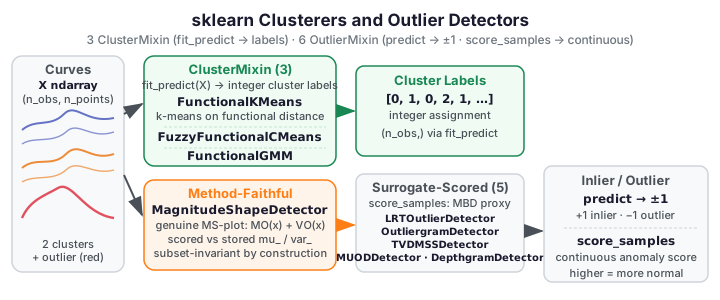
All estimators follow the plain-ndarray contract: input X is (n_obs, n_points);
argvals (default None) sets the evaluation grid at construction. See the
coverage / EXCLUDE list for excluded functional clustering and outlier
methods (cluster_optim).
Clusterers
ClusterMixin estimators perform unsupervised grouping of functional curves.
fit_predict is the primary interface — it returns integer cluster labels directly.
| Estimator | sklearn mixin | fdars source | Key constructor params |
|---|---|---|---|
FunctionalKMeans |
ClusterMixin |
fdars._native.clustering.kmeans_fd |
n_clusters=3, max_iter=100, tol=1e-6, argvals=None |
FuzzyFunctionalCMeans |
ClusterMixin |
fdars._native.clustering.fuzzy_cmeans_fd |
n_clusters=3, fuzziness=2.0, max_iter=..., argvals=None |
FunctionalGMM |
ClusterMixin |
fdars._native.clustering.gmm_cluster |
n_clusters=3, nbasis=5, max_iter=200, argvals=None |
FunctionalKMeans
k-means clustering on functional data using the fdars-native functional distance.
Cluster centres are functional curves, not scalar vectors. Converges when the
maximum centre movement falls below tol. This estimator passed the full
check_estimator battery at zero failures without fixes (Phase 55 baseline).
FuzzyFunctionalCMeans
Fuzzy c-means clustering where each observation has a soft membership degree to
every cluster (not a hard assignment). The fuzziness parameter (default 2.0)
controls the degree of fuzziness: higher values blur cluster boundaries. n_iter_
is set to max_iter at fit time (the native method does not expose an iteration
count; this follows the same convention as LogisticFPCClassifier).
FunctionalGMM
Gaussian mixture model for functional data, represented in a B-spline basis of
nbasis elements. Cluster membership is probabilistic. n_iter_ is set to
max_iter at fit time (native exposes BIC/ICL but no EM iteration count).
Outlier Detectors
OutlierMixin estimators label each observation as an inlier (+1) or outlier
(-1) via predict. The continuous anomaly score is available via
score_samples (higher = more normal / more inlier).
| Estimator | sklearn mixin | fdars source | Key constructor params |
|---|---|---|---|
LRTOutlierDetector |
OutlierMixin |
fdars._native.outliers.detect_outliers_lrt_with_dist (fit-time provenance); depth surrogate at score time |
contamination=0.1, alpha=0.05, argvals=None |
OutliergramDetector |
OutlierMixin |
fdars._native.depth.modified_band_1d (surrogate score); MEI/MBD stored as provenance |
contamination=0.1, factor=1.5, argvals=None |
MagnitudeShapeDetector |
OutlierMixin |
fdars._native.outliers.magnitude_shape (method-faithful MS-plot score) |
contamination=0.1, argvals=None |
TVDMSSDetector |
OutlierMixin |
fdars._native.depth.modified_band_1d (surrogate); TVD/MSS arrays stored as provenance |
contamination=0.1, emp_factor_mss=1.5, argvals=None |
MUODDetector |
OutlierMixin |
fdars._native.depth.modified_band_1d (surrogate); MUOD index arrays stored as provenance |
contamination=0.1, factor=1.5, argvals=None |
DepthgramDetector |
OutlierMixin |
fdars._native.depth.modified_band_1d (surrogate); shape/magnitude outlier indices stored as provenance |
contamination=0.1, outliergram_factor=1.5, argvals=None |
Method-accuracy honesty
MagnitudeShapeDetector is the only method-faithful detector in this module.
Its score_samples uses a genuine MS-plot decomposition:
- Magnitude outlyingness
MO(x) = mean_t(|x(t) − μ(t)|)against the stored pointwise training meanmu_. - Shape outlyingness
VO(x) = mean_t(|(x(t) − μ(t))² − σ²(t)|)against the stored pointwise training variancevar_. - Combined score
−(MO² + VO²)(higher = more inlier).
These statistics are computed against fixed stored training statistics
(mu_, var_), so scoring a subset of test curves returns the same values as
scoring them individually — check_methods_subset_invariance passes.
The other five detectors (LRTOutlierDetector, OutliergramDetector,
TVDMSSDetector, MUODDetector, DepthgramDetector) rank by a
subset-invariant modified-band-depth surrogate in the sklearn layer. Their
eponymous batch-relative native methods (LRT bootstrap, outliergram MEI/MBD,
TVDMSS, MUOD, depthgram) are whole-batch statistics with no per-row
decomposition — they cannot satisfy check_methods_subset_invariance directly.
The sklearn wrappers compute modified_band_1d(X_new, X_fit_) (depth of new
curves against the stored training population) as a subset-invariant proxy,
while retaining the original native-method outputs as provenance attributes
(e.g. mbd_train_, mei_train_, tvd_train_, mss_train_).
Use fdars.outliers directly when you need the exact batch-relative scores
from these methods.
Typical Usage
Clustering (unsupervised):
from sklearn.pipeline import Pipeline
from fdars.sklearn._skeletons import BSplineSmoother, FunctionalKMeans

pipe = Pipeline([
    ("smoother",  BSplineSmoother()),
    ("clusterer", FunctionalKMeans(n_clusters=3)),
])
labels = pipe.fit_predict(X)
Outlier detection:
from fdars.sklearn._skeletons import MagnitudeShapeDetector

det = MagnitudeShapeDetector(contamination=0.05)
det.fit(X_train)
labels = det.predict(X_test)   # +1 inlier, -1 outlier
scores = det.score_samples(X_test)  # higher = more normal
For the five surrogate-scored detectors, score_samples is available and returns the
modified-band-depth values; use fdars.outliers for the method-exact scores.